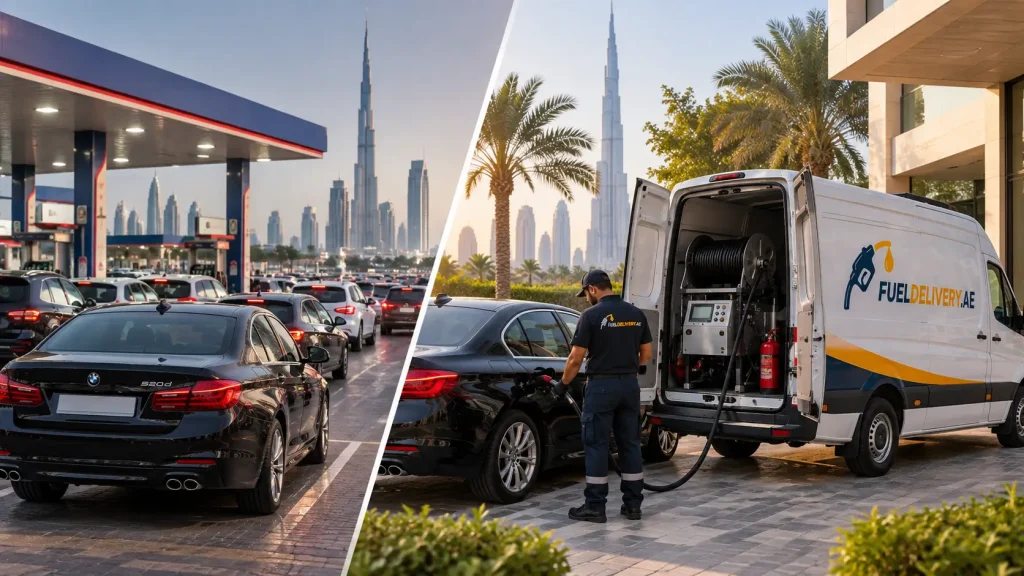
Dubai fuel delivery van refueling a BMW near a busy petrol station and Burj Khalifa

The Real Cost of Refueling a Car in Dubai: More Than the Price of Petrol

At around 6:15 pm in Al Quoz, a driver checking the fuel gauge sees the tank has dropped to a quarter. The nearest petrol station is only a few minutes away on paper, but at Dubai’s evening traffic speeds, that quick stop can become a detour, a queue and another interruption to the journey home. The pump shows AED 3.69 per litre for Special 95 in September 2026. But for someone comparing that station visit with fuel delivery in Dubai, the number on the pump is only the starting point.The more useful question is what that refueling actually costs once the entire trip is counted. There is the petrol itself, but also the fuel used getting to the station, the time spent in traffic and at the pump, and how often that entire process has to be repeated. Looking at those costs together changes the comparison between driving to a station and having fuel delivered and reveals why a delivery fee cannot be judged in isolation.

What Does Refuelling a Car in Dubai Really Cost?

The obvious cost is simple: petrol price × litres purchased. A 50-litre fill at September 2026’s Special 95 rate of AED 3.69 costs AED 184.50 the number on the receipt, and usually the only one anyone tracks.But that receipt misses everything around it: the fuel burned reaching the station and back, the minutes spent driving and queuing, and the mental overhead of fitting a stop into an already busy day. None of this replaces petrol as the biggest expense it sits alongside it, and for some drivers, in some situations, it adds up to something worth noticing.

The Petrol Price Is Only the Starting Point

UAE fuel prices are set monthly by the Fuel Price Committee based on global market conditions. As of September 2026: Super 98 at AED 3.80, Special 95 at AED 3.69, E-Plus 91 at AED 3.61, and diesel at AED 4.30. That rate applies identically whether you fill up at a station or have fuel delivered providers like CAFU charge the same government-regulated per-litre price, with delivery adding a separate fee rather than a fuel markup.That’s the key distinction behind fuel delivery prices in Dubai: the petrol price itself never changes with the method. What’s actually comparable is everything around it, the fee for bringing fuel to you, versus the cost of getting yourself to where it already is.

The Hidden Cost of Driving to a Petrol Station

A detour is rarely free, even a short one. Fuel burns in both directions, and in Dubai that happens against real traffic pressure TomTom’s 2025 Traffic Index found drivers lost an average 72 hours to congestion that year, with rush-hour speeds of just 26.3 km/h and a typical 10km drive taking 19.1 minutes, both worse than 2024.What that data can’t offer is one universal “average visit time”: a station off a quiet road at 11am is nothing like one on Sheikh Zayed Road at 6pm. That variation is exactly what a dedicated look at petrol station visit time will unpack separately, comparing a quick visit against a much longer one using real local traffic data. 

Why “Just Topping Up” Can Cost More Than It Looks

Filling fully means fewer total trips over a month. Topping up smaller amounts more often means repeating the detour, queue, and time cost more frequently even though the price per litre never changes based on quantity.That distinction matters: topping up doesn’t make fuel itself pricier, it just multiplies how often the whole station-visit process repeats. Someone topping up weekly repeats that cost roughly four times more than someone filling once a month. Whether that adds up to something meaningful over a year is worked out properly when you look at petrol top-up costs. 

When Does Fuel Delivery Actually Make Financial Sense?

Here’s the comparison the article has been building toward. Station refuelling costs fuel, plus travel, plus time, plus any downtime. Delivery costs the same fuel, plus a delivery fee. Since fuel price is identical either way, the whole comparison rests on one thing: is the delivery fee smaller than everything else you’d spend getting to a station yourself?Fuel delivery vs petrol station Dubai has no single universal answer, because the inputs shift the outcome. CAFU currently charges AED 12 for overnight delivery, AED 16 for standard (two-hour) delivery, and AED 20 for priority (20-minute) delivery, each plus a flat AED 2.95 service fee. Beyond the fee, the answer also turns on how far the nearest station sits, how much your time is worth, your vehicle’s efficiency, how often you refuel, and for a business how many vehicles are involved and what an hour of downtime costs.

The Break-Even Point: How to Compare Station Costs With Delivery

Simply put: delivery starts making sense once delivery fee < avoidable cost of the station trip. “Avoidable cost” is rarely just fuel; it includes the time the detour and queue consume and, for a business vehicle, the cost of that vehicle being off the job. A short, easy detour might make even a modest delivery fee not worth paying; a longer one through rush-hour traffic can flip the answer quickly. Rather than assert one break-even number that won’t hold for most readers, fuel delivery costs work through several realistic fee-and-detour scenarios to show exactly where that tipping point sits. 

Station vs Delivery: The Cost Changes Over a Full Year

Every calculation so far covers one refueling event but a single event can mislead. Someone refuelling twice a month faces a very different annual total than someone refuelling weekly, even with similar per-visit costs. Multiply either across 12 months, factoring in total trips, mileage, cumulative time versus cumulative fees, and the comparison can shift meaningfully.That gap is exactly what a single visit can’t show. A full annual ledger annual fuel costs builds this out properly for an illustrative Dubai driver, with every assumption stated rather than treated as a universal average. 

What This Means for Dubai Drivers and Businesses

For individual drivers, it comes down to personal factors: how much your time is worth, how disruptive a detour is, and how often you genuinely refuel. For businesses running delivery vehicles or fleets, it shifts toward operational cost a driver off-route refueling isn’t earning during that time, and across several vehicles, that downtime becomes a real, measurable expense rather than a minor inconvenience.In neither case does delivery automatically win. It depends on usage patterns, fleet size, and how convenient the alternative genuinely is which is exactly why it’s worth calculating rather than assuming.

The Real Question Isn’t Petrol Price It’s Total Refuelling Cost

Petrol price remains, by far, the biggest single expense; nothing here changes that. What changes is recognising it isn’t the only relevant cost when comparing refuelling methods. Petrol price, the station trip, plus the time it consumes, plus how often you repeat it, plus what delivery would cost instead together, that’s the real economics of keeping a car fuelled in Dubai.This isn’t an argument that delivery always wins, or that station trips are always wasteful. It’s an argument that the comparison is calculable and most drivers have never run the numbers, because the petrol price is the only figure anyone puts in front of them. The four dedicated pieces introduced above exist to run those numbers properly, one variable at a time.

Frequently Asked Questions

How much does fuel delivery cost in Dubai?Fuel is priced the same as any station. On top, CAFU charges AED 12 (overnight), AED 16 (standard), or AED 20 (priority), plus a flat AED 2.95 service fee.Is fuel delivery more expensive than going to a petrol station?Not in fuel cost that’s identical. Overall cost depends on whether the delivery fee outweighs the travel and time of a station visit for you.What is included in the cost of fuel delivery?The current fuel price plus a delivery fee, which varies by how quickly you need it delivered.Is fuel delivery worth it in Dubai?It depends on your situation, detour distance, how much your time is worth, and how often you refuel all shape the answer.Does fuel delivery save time compared with visiting a petrol station?Usually yes, since it skips travel and queuing though the actual time saved depends on distance to the nearest station and traffic.

Related Posts