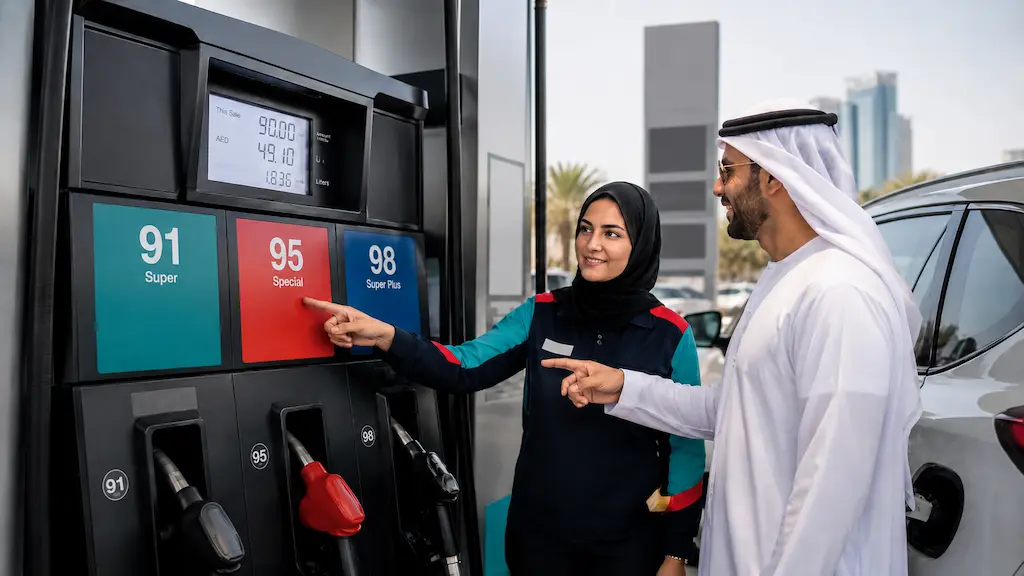
A few weeks ago, a driver in Al Barsha called us in a bit of a panic. He had just moved to Dubai, pulled up to a fuel station, and been asked, “Special or Super?” by the attendant, a question he had no idea how to answer. He ended up choosing Super 98 out of caution, only to find out later that his sedan was designed to run perfectly well on Special 95. No harm done, but he had spent extra dirhams unnecessarily.
It’s a more common mix-up than you might think. In the UAE, filling up doesn’t simply mean choosing “petrol.” Drivers have different fuel grades to choose from, and selecting the wrong one can either cost you more money than necessary or, in certain circumstances, affect engine performance.
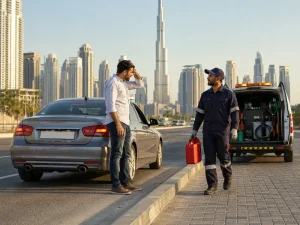
For drivers who prefer convenience, petrol delivery in Dubai can also make refueling easier by bringing the required fuel directly to your location.
Here’s a clear breakdown of the main petrol grades available in the UAE, what each one is designed for, and how to determine which grade your car actually needs.
Quick Answer: The UAE offers three main petrol grades E-Plus 91, Special 95, and Super 98 plus diesel for commercial and diesel-engine vehicles. Most everyday sedans and SUVs run on Special 95. Super 98 is for high-performance and luxury engines that specifically require it. E-Plus 91 is the budget option, mainly suited to older or low-compression engines. Check your fuel cap or owner’s manual to confirm which grade your manufacturer recommends.
The Petrol Grades Available in the UAE
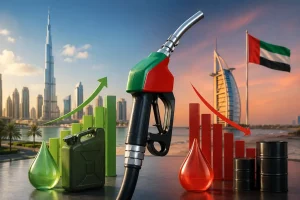
Every major fuel provider in the country ADNOC, ENOC/EPPCO, and Emarat sells the same three petrol grades, priced identically nationwide regardless of emirate.
| Fuel Type | Octane Rating | Best For | August 2026 Price (AED/litre) |
|---|---|---|---|
| E-Plus 91 | 91 | Older vehicles, small-displacement economy cars, commercial fleets | 3.41 |
| Special 95 | 95 | Most modern sedans and SUVs (Toyota, Nissan, Hyundai, etc.) | 3.49 |
| Super 98 | 98 | High-performance, turbo, and luxury engines | 3.60 |
| Diesel | – | Trucks, buses, and diesel-engine SUVs and pickups | 3.80 |
These figures are set monthly by the UAE Fuel Price Committee and reported consistently by outlets like Khaleej Times and Gulf News. Rates apply uniformly across Dubai, Abu Dhabi, Sharjah, and the Northern Emirates, so no matter where you fill up, you’re paying the same price for the same grade.
What “Octane Rating” Actually Means
The number attached to each fuel grade 91, 95, or 98 is the Research Octane Number (RON). In plain terms, it measures how well the fuel resists “knocking,” a form of premature combustion that can stress an engine over time. Higher-compression engines need higher-octane fuel to burn cleanly and efficiently; lower-compression engines don’t need it and won’t benefit from it.
- E-Plus 91: The most budget-friendly petrol in the UAE, designed for engines with a low compression ratio. Common in older Japanese models and fleet vehicles built for economy over performance.
- Special 95: The default choice for the majority of UAE-spec sedans and SUVs. It balances performance, efficiency, and price, which is why most manufacturers recommend it as standard.
- Super 98: Built for high-compression, turbocharged, or luxury engines that are specifically tuned to use it. Filling a regular sedan with Super 98 rarely causes harm, but it also rarely delivers any noticeable power or efficiency gain, you’re just paying more per liter for nothing. Our deeper look at whether premium petrol actually improves your car’s performance covers this in more detail if you’re deciding whether the upgrade is worth it.
How to Know Which Petrol Grade Your Car Needs
Callout: Never guess. The two most reliable sources are:
- The fuel flap or fuel cap most UAE-spec vehicles print the recommended octane rating directly on the inside of the flap
- The owner’s manual under the “fuel requirements” or “specifications” section, the manufacturer lists the minimum and recommended octane rating
If your manual says “regular” or “unleaded,” Special 95 is almost always the correct choice. If it specifically says “premium” or lists a minimum octane of 95 or higher for a turbocharged engine, Super 98 is the safer call.
What Happens If You Use the Wrong Grade
Using a slightly higher octane than required is generally harmless, you just spend more without gaining anything. Going the other direction is riskier:
- Using E-Plus 91 in an engine designed for Special 95 or Super 98 can cause knocking, reduced power, and long-term wear on components not built to handle it
- Using diesel in a petrol engine, or petrol in a diesel engine, causes serious mechanical damage almost immediately and typically requires the fuel system to be professionally drained
If this ever happens to you, don’t try to start the car or drive it. Our guide on what happens if you put the wrong fuel in your car explains exactly what to do next and how delivery and drain services handle it safely.
Does the Petrol Type Affect Fuel Efficiency?
To a degree, yes but not in the way most drivers assume. Using the octane grade your manufacturer actually recommends gives you the efficiency the engine was designed for. Using a higher grade than necessary doesn’t improve efficiency in a standard engine; the gains only show up in engines specifically tuned to exploit higher-octane fuel. In other words, matching the grade to your car matters more than chasing the highest number on the pump.
Where to Find Each Petrol Grade in Dubai
All three petrol grades and diesel are available at virtually every ADNOC, ENOC, and Emarat station across Dubai from Sheikh Zayed Road to Al Quoz, Deira, and Jumeirah. The challenge isn’t availability; it’s what happens when you’re already running low and can’t get to one. That’s a situation we deal with daily, delivering Special 95 and Super 98 petrol directly to drivers stranded on Dubai’s highways, in residential parking, or simply too far from the nearest station to make it safely.
Frequently Asked Question
Is Super 98 better than Special 95?
Not universally “better” depends entirely on what your engine is built for. Super 98 only offers a real benefit in high-compression or turbocharged engines designed to use it.
Can I mix petrol grades, like adding Super 98 to a tank that already has Special 95?
Yes, mixing grades is safe. The fuel simply blends, and the resulting octane rating sits somewhere between the two, it won’t damage the engine.
Is E-Plus 91 bad for modern cars?
It’s not “bad” so much as unsuitable for most modern engines, which are tuned for 95 octane or higher. Using 91 in a car that requires 95 can cause knocking and reduced performance over time.
Do fuel prices differ between emirates?
No. The UAE Fuel Price Committee sets one national price per grade each month, so Special 95, Super 98, E-Plus 91, and diesel all cost the same whether you’re in Dubai, Abu Dhabi, Sharjah, or Ajman.
Conclusion
Choosing the right petrol grade isn’t about spending more for peace of mind, it’s about matching the fuel to what your engine was actually built for. Check your fuel cap, stick with the recommended grade, and you’ll get the performance and efficiency your manufacturer intended without wasting money on fuel your car doesn’t need.
And if your tank runs dry before you make it to a station, our team brings Special 95 or Super 98 straight to you, anywhere across Dubai. See how our fuel delivery service works book fuel delivery now and get back on the road without the detour.