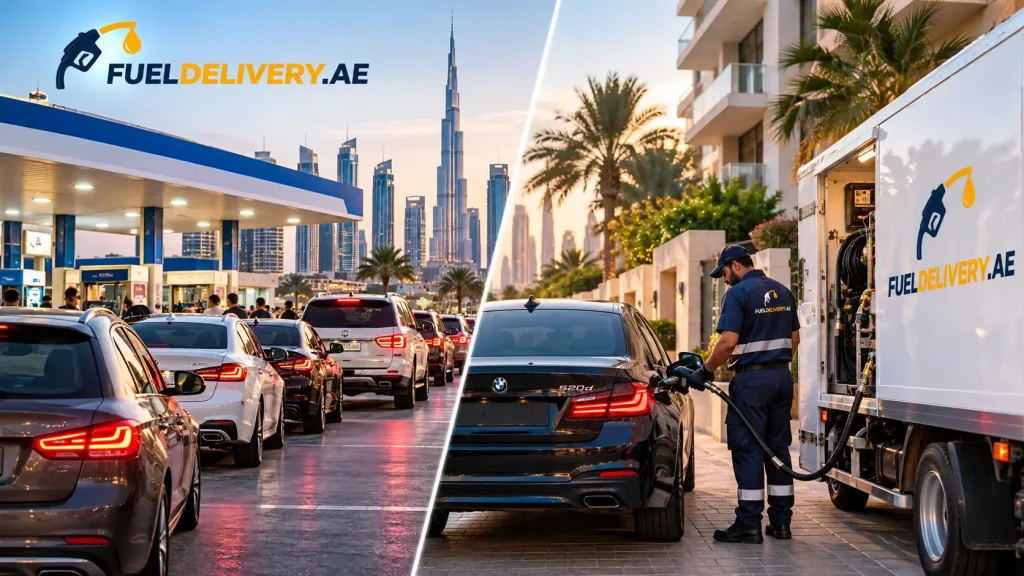
At the start of the year, a Dubai driver may not think twice about stopping at a petrol station. The fuel gauge drops, the car needs petrol, and the station is simply part of the routine. But when that same journey is repeated dozens of times over 12 months, the cost is no longer limited to what appears on the fuel receipt. For drivers using fuel delivery in Dubai, the more useful comparison is between the total cost of making those station trips and the cost of having fuel brought to the vehicle.The difference becomes clearer when the year is viewed as a complete ledger rather than as one refuelling stop. Petrol prices change during the year, while traffic, distance, waiting time and refuelling frequency continue to affect how much effort each station visit requires. This makes fuel delivery vs petrol station a broader cost question than simply comparing the price per litre.
This is why a direct comparison between the fuel delivery price Dubai and the pump price can be misleading. Delivery does not replace the cost of fuel; it replaces part of the journey involved in obtaining it.For a driver who passes a petrol station every day anyway, that difference may be small. For someone making a separate trip specifically to refuel, the calculation starts to look different.
This is not a claim that delivery will automatically produce a lower annual bill. The result depends on how far the driver travels to refuel, how frequently they refuel, when those trips happen and what delivery fee applies.The purpose of the 12-month comparison is to show where the money and time actually go.
What a Year of Refuelling Actually Looks Like
Consider a representative Dubai driver rather than an assumed statistical “average.” The driver uses a petrol car regularly for commuting, errands and weekend journeys and refuels throughout the year. Some months involve more driving than others, so the number of visits naturally changes.The important point is that every refuelling method creates two separate costs: the fuel itself and the process of obtaining it. The first is easy to see on the receipt. The second is spread across kilometres driven to the station, traffic delays, waiting and the driver’s time.That distinction matters because Dubai’s fuel prices moved significantly during 2026. According to the UAE’s monthly pricing data, Special 95 was AED 2.42 per litre in January, rose to AED 3.83 in June and stood at AED 3.69 in September. The full monthly movement is documented in our full 2026 fuel-price data trail.The Petrol Cost Is Only One Part of the Ledger
The petrol price does not change simply because a driver chooses a petrol station or delivery. If the same amount of fuel is purchased, the underlying litres still have to be paid for.What changes is everything around that purchase.| Cost element | Petrol station | Fuel delivery |
| Petrol or diesel | Paid | Paid |
| Drive to station | Usually required | Avoided |
| Return or route adjustment | May apply | Avoided |
| Traffic exposure | Depends on timing | Usually reduced |
| Queue or pump waiting | Possible | Generally avoided |
| Driver’s time | Used for the trip | Reduced |
| Delivery charge | None | Applies |
What a Dubai Driver Gives Up at the Station
Dubai’s traffic data provides useful context for the time involved. TomTom’s 2025 Traffic Index recorded an average 10-kilometre journey in Dubai at 19 minutes and 10 seconds, increasing to 26 minutes and 33 seconds during evening rush hour.Those figures are not petrol-station queue times, and they should not be treated as one. They show something more useful: the same distance can require substantially more time depending on when it is driven.A refueling trip can therefore be relatively simple during a quiet period but become much less convenient when it involves busy roads, a station entrance, queues or a route away from the driver’s normal journey.Over one year, these small differences accumulate. A five-minute delay is easy to dismiss once. Repeated across dozens of refuelling trips, however, the driver’s total time spent obtaining fuel becomes much more noticeable.The 12-Month Station vs Delivery Ledger
A useful way to compare the two options is to track what happens across an entire year rather than focusing on one visit.Imagine a driver who refuels regularly throughout 12 months. With the station model, every refueling event involves some combination of travelling to the station, joining the road network, waiting for an available pump and continuing the journey afterwards.With delivery, the same driver still pays for the fuel but removes the dedicated station journey. Instead, a delivery fee is added to the transaction.The annual ledger therefore looks something like this:| Annual factor | Station model | Delivery model |
| Fuel purchased | Same underlying requirement | Same underlying requirement |
| Dedicated refuelling trips | Yes, when a station visit is needed | No |
| Extra kilometres | Depends on route | Usually lower |
| Traffic exposure | Higher when travelling specifically to station | Reduced for the refuelling task |
| Waiting time | Possible | Generally avoided |
| Delivery charge | No | Yes |
| Convenience | Depends on location and timing | Higher when refuelling can happen where the vehicle is parked |