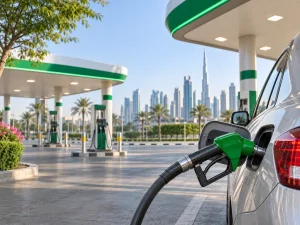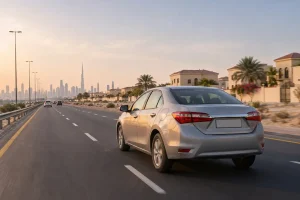
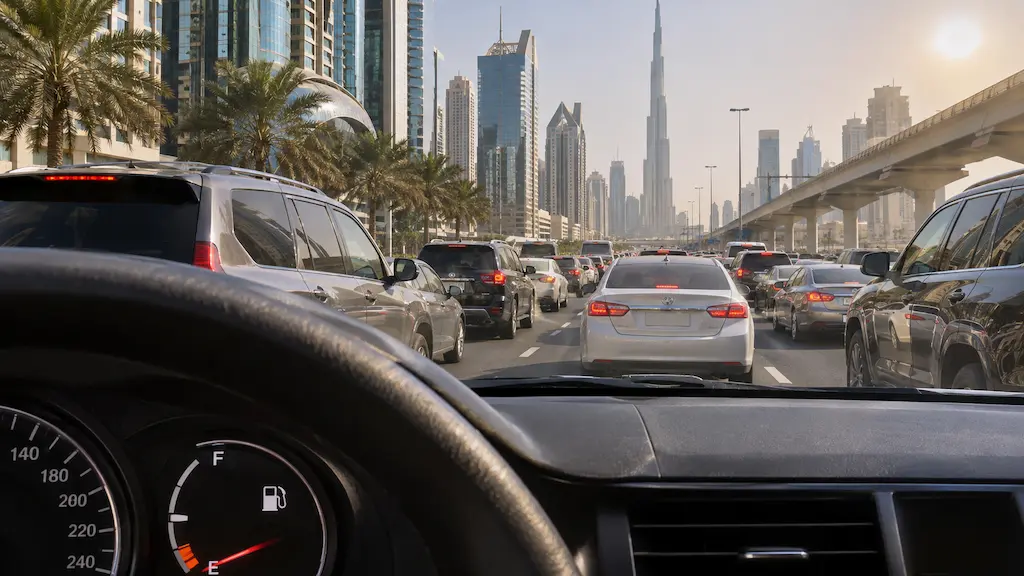
It was 6:15 in the evening on Sheikh Zayed Road, and the drive that takes twenty minutes on a Friday morning had already taken forty. The air-conditioning was running, the car had barely moved in ten minutes, and the petrol gauge seemed to drop faster than the trip meter. It raises a fair question: is traffic actually using more petrol, or does it just feel that way because the journey takes longer? The short answer is yes but not in the way most drivers imagine. If a traffic-heavy week leaves you running low, arranging fuel delivery in Dubai can get you moving again without an extra station trip, but first it helps to understand where that extra petrol is really going.
A car uses petrol most efficiently at a steady speed, with few stops and little time spent standing still. Traffic breaks all three of those conditions at once.
In stop-start traffic, the engine repeatedly accelerates a heavy car from a standstill, only for the driver to brake again a short distance later. That acceleration is the most fuel-hungry part of city driving. At the same time, long stationary periods burn petrol while the car covers no distance at all, so the litres-per-100-km figure rises even if the engine is doing nothing unusual.
That is why two identical cars on the same route can return very different fuel figures in different weeks. One week may include open roads and steady speeds. The next may include school-run congestion, signal queues, and a long wait outside a mall entrance all with the air-conditioning running throughout.
Not All Traffic Is Equal
It helps to split “traffic” into three very different situations, because they waste fuel in different ways.
1. Crawling stop-start traffic
This is the most expensive kind. Repeated acceleration and braking, short bursts to close a gap, and constant low-speed running all push consumption up. Guides for UAE driving commonly cite aggressive acceleration and braking as a major factor in stop-and-go conditions, with the U.S. Department of Energy quoted for aggressive driving lowering mileage by up to 30% at highway speeds and up to 40% in stop-and-go traffic. Those are upper-range figures, not a promise for every car, but they show why driving style matters most in exactly this kind of traffic.
2. Long stationary idling
Sitting still with the engine running uses petrol without adding a single kilometer. How much depends on engine size and whether the AC compressor is working hard. Published idling guides put a typical range at roughly 0.5 to 1.5 liters per hour for a passenger car, with smaller engines at the lower end and larger engines, or heavy AC use, at the higher end. One guide puts a compact petrol car at around 0.6 liters per hour idling and a large petrol car at around 1.5 liters per hour. The exact figure for your car will differ, but the direction does not: an hour of idling is an hour of fuel with no distance to show for it.
3. Slow but moving traffic
Steady, slow movement is better than constant stopping, even if it feels frustrating. If the car keeps rolling at a low, even speed, it avoids the repeated acceleration penalty. This is why leaving a larger gap and rolling forward gently, rather than rushing to the next bumper and braking, usually saves fuel in a queue you are still in traffic, but you are spending less of it accelerating.
Dubai Adds a Second Load: Air-Conditioning
In many cities, traffic alone is the story. In Dubai, traffic and cooling arrive together.
When the car is crawling or stationary, the air-conditioning compressor still draws energy from the engine to keep the cabin comfortable. That means idling in Dubai summer heat costs more petrol than idling in mild weather with the AC off. It also means the fuel penalty of a traffic jam is larger on a hot afternoon than on a cool evening, even for the same queue.
This is also why short trips in traffic feel especially expensive. A car parked in direct sunlight needs a strong initial cooling effort, and if the journey is short and traffic-heavy, that cooling effort makes up a large share of the whole trip. For a fuller explanation of that cooling effect, see our guide on how air conditioning affects petrol consumption.
The practical point is not to switch the AC off and suffer. It is to avoid the two worst combinations where you can: long stationary waiting with the AC at full blast, and repeated short, hot, traffic-heavy trips that never let the car settle into steady running.
How Much More Does Traffic Actually Cost?
There is no single percentage that fits every car, route, and week, and any article that gives you one without caveats is guessing. The honest way to put it is in ranges, from published guides:
- Stop-start driving is commonly cited as increasing fuel use by around 10–15% compared with free-flow conditions, with idling alone accounting for roughly 5–8% of total fuel use in one guide’s figures.
- Idling itself is commonly cited at roughly 0.5 to 1.5 liters per hour for a passenger car, depending on engine size and AC load.
- Aggressive acceleration and braking in stop-and-go conditions is cited at the upper end as lowering mileage by up to 40%, which is a worst-case driving-style figure, not an average traffic penalty.
To turn that into your own number, measure it rather than trusting a generic claim. Fill the tank fully, reset the trip meter, drive normally, then refill fully and divide kilometers by liters. Do that for a normal week and again for a traffic-heavy week on similar routes. If the figure drops from, say, 12 km/L to 10 km/L, you have a real, personal traffic effect and you also have a baseline to test whether smoother driving or a different departure time actually helps.
How to Reduce the Traffic Penalty Without Changing Your Route
You cannot remove Dubai traffic, but you can reduce how much of it your engine pays for.
Drive for the queue, not the gap. Look several cars ahead, lift off early when traffic slows, and roll rather than rushing forward and braking. Smooth, steady inputs beat fast bursts in a queue every time.
Leave a little more space. A larger following distance gives you room to keep rolling instead of stopping completely at every wave. You will still arrive at the same queue, but with fewer full stops.
Use start-stop where your car has it. Modern auto start-stop systems are designed for long stops in heavy traffic. Letting the system work, rather than disabling it by habit, avoids the idling penalty at longer lights and queues. For a manually driven older car, switching off is worth considering only for a genuinely long, safe stop not for every few seconds of crawling.
Avoid unnecessary long idling. If you are waiting to pick someone up, parked outside a school, or sitting in a car park with the engine running, consider switching off once the cabin is comfortable and it is safe to do so. The AC will not stay cold forever with the engine off, so this is a balance, not a rule to suffer by.
Combine short trips. Several short, traffic-heavy trips with parking in between mean repeated cold starts and repeated cabin cooling. One combined trip, where it is practical, usually uses less petrol than the same stops made separately.
Check the basics. Under-inflated tyres increase rolling resistance and make the engine work harder in exactly the slow, repeated-acceleration conditions where traffic already hurts. A quick tyre-pressure check is one of the cheapest fuel-saving habits in Dubai heat.
When Traffic Is Not the Whole Story
Traffic is a common cause of higher consumption, but it should not automatically take all the blame. If your fuel figure has jumped suddenly and stayed high even on open roads, or if it comes with warning lights, rough running, or a noticeable loss of performance, something else may be involved tyre pressure, a dirty air filter, a faulty sensor, worn spark plugs, or a change in driving habits.
That distinction matters, because it decides whether you need a smoother week or a workshop visit. For a structured way to work through the other causes, see our guide on why your car is suddenly using more petrol than before.
A useful test is simple: compare a traffic-heavy week with an open-road week on similar routes, measured in litres per 100 km over several refills, not by watching the gauge or the amount you pay. If the open-road figure is back to normal, traffic was the main cause. If it is not, the car needs checking.
Frequently Asked Questions
Does Dubai traffic increase fuel consumption?
Yes. Stop-start driving, repeated acceleration and braking, and long idling all increase petrol use compared with steady driving. Dubai heat adds to the effect because the air-conditioning keeps working while the car is crawling or stationary.
How much fuel does idling use?
Published guides put a typical passenger car at roughly 0.5 to 1.5 liters per hour at idle, depending on engine size and AC load, with a compact petrol car around 0.6 liters per hour and a large petrol car around 1.5 liters per hour in one guide. Your exact figure will vary, but idling always uses fuel with no distance gained.
Is it better to switch the engine off in traffic?
For a long, safe stop, yes a warmed-up modern engine uses less fuel restarting than it would idling for that period, and auto start-stop systems are designed to do this automatically. For very short stops in crawling traffic, constant manual switching is not practical, so let the car’s system handle it where fitted.
Does traffic affect fuel use more than AC?
They compound each other rather than competing. Traffic creates the stop-start and idling conditions, and AC adds load during exactly those conditions. In Dubai summer, a traffic jam with the AC running is the most expensive combination of the two.
Can changing my departure time really save petrol?
It can, if it moves you from crawling stop-start traffic to steadier movement. Even a modest shift away from peak congestion, or a route with fewer signals and merges, can reduce the repeated-acceleration and idling penalties that drive the traffic effect.