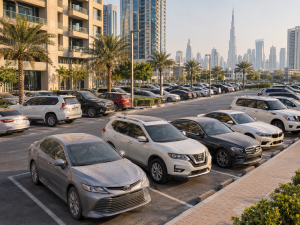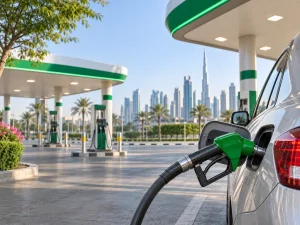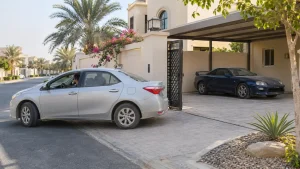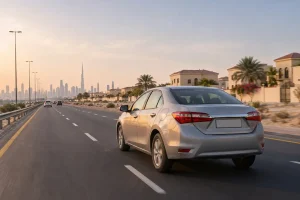
Same car, same job in DIFC, same 8 o’clock start. Omar lives in a tower in Dubai Marina; his brother Faisal lives in a villa in Arabian Ranches. At the end of the month, Faisal’s petrol bill is higher, but not by as much as the extra kilometers suggest, and on some months Omar’s is worse. The difference is not the car or the driver. It is the geography between home and everything else: how far, how fast, how often the car stops, and how long it sits baking in the sun between trips. Where you live in Dubai quietly sets your fuel consumption before you ever turn the key until a fuel delivery in Dubai call at midnight makes you ask where it all went.
Your Address Is a Fuel Decision
Most drivers think about petrol in terms of the car: engine size, age, driving style. All of those matter, but they sit on top of a bigger variable nobody chooses for fuel reasons, where home is. Four forces decide what your address costs you in petrol, and they do not all point the same way.
Distance is the obvious one: more kilometers, more liters. Traffic type is the second: the same ten kilometers costs very different amounts of fuel at a steady cruise versus in stop-start crawling. Road type is the third: open highways let an engine settle into its efficient band, while local streets mean constant slowing and starting again. Parking and cooling is the fourth, and the most Dubai-specific: a car parked in direct sun needs a hard cooling effort every time it moves.
These forces pull against each other: the driver who lives furthest usually drives the fastest roads, and the driver who lives closest often drives the slowest ones.
Four Dubai Driving Profiles
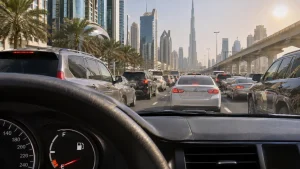
Central high-rise: Dubai Marina, JLT, Downtown, Business Bay. Short distances, dense everything. The commute to DIFC or Business Bay may be only 15–20 km each way, but much of it is spent in queues, at signals, and crawling through car parks. The car rarely reaches a steady cruise, and every trip starts with a sunbaked cabin. The saving grace is choice: metro and tram cover much of this corridor, so some trips never touch the car.
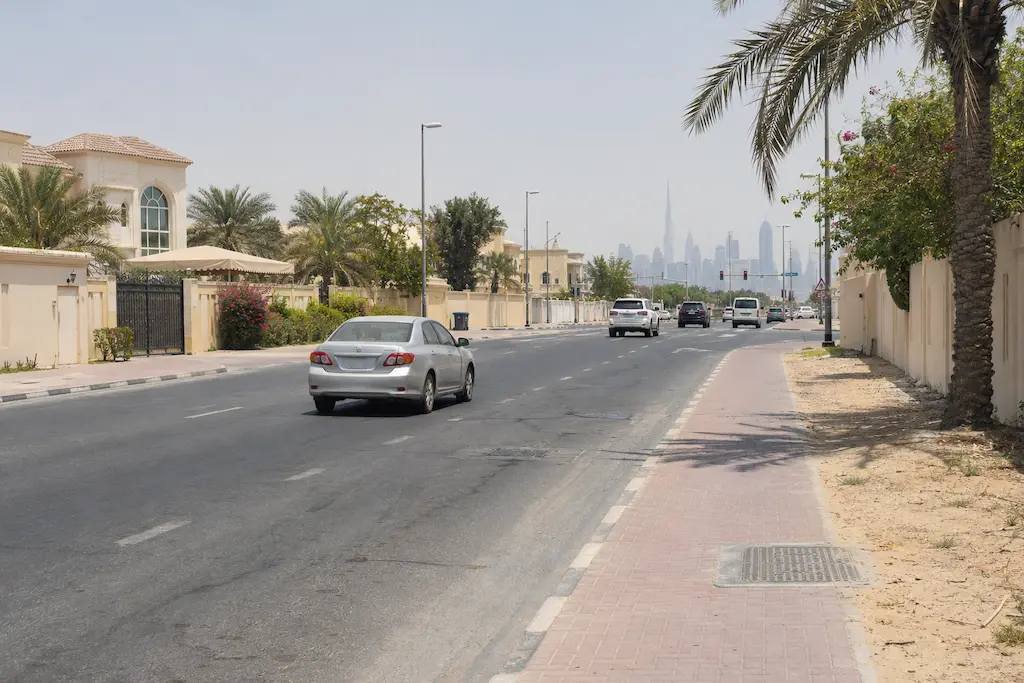
Suburban villa: Arabian Ranches, Dubai Hills, Damas Hills, Motor City. Longer distances, freer roads. There is no metro, so the car does everything: the commute, the school run, the supermarket, the weekend. A Ranches-to-Downtown drive is about 25 minutes off-peak on Sheikh Mohammed Bin Zayed Road, stretching to 40 minutes or more at peak, but most of it is steady highway running, where an engine is at its most efficient. The bill here is driven by kilometers, not congestion.
Outer and fringe: Dubai South, Jebel Ali, Discovery Gardens, International City, Midriff. The longest commutes in the city, mostly on highways. A driver here can cover 60–80 km a day without ever seeing truly slow traffic, which keeps the litres-per-100-km figure respectable, but the sheer distance still makes the monthly total the highest of the four. This is also where running dry hurts most: the next station is further away, and late at night the gap feels longer still.
Old Dubai: Deira, Bur Dubai, Al Quassia, Al Nahda. Dense, older roads, short trips, heavy congestion around the Creek crossings plus, for many residents, a cross-emirate commute from Sharjah, where a daily Al Nahda-to-Dubai run adds up fast over a month. Distances look small on the map, but the driving is the thirstiest kind: short, slow and stop-start, with the AC working throughout.
The Same Car, Three Addresses: A Worked Example
Take one ordinary car, a mid-size sedan and put it at three addresses, with the same job in DIFC and the same 22 working days a month. These are illustrations built from the published figures in Part A, not measurements, and they cover commuting only.
Omar in Dubai Marina. About 40 km a day round trip, 880 km a month, in traffic-heavy driving, so the car returns about 10 liters per 100 km. That is 88 liters a month.
Faisal in Arabian Ranches. About 55 km a day round trip, 1,210 km a month nearly 40% further, but mostly steady highway running, so the car returns about 8.5 liters per 100 km. That is 103 liters a month: more than Omar, but only by about a sixth.
Layla in JVC, working in Business Bay. About 28 km a day round trip, 616 km a month, at about 9 liters per 100 km on mixed roads: 55 liters a month the lowest of the three, by a wide margin.
Distance and efficiency pull in opposite directions, and the winner is usually the middle: a moderate distance on roads that actually flow. The Marina driver pays for congestion, the Ranches driver pays for distance, and the JVC driver pays for neither at full strength.
In dirhams, the gap depends on the month, because UAE petrol prices are revised monthly. Using the February 2026 range of about AED 2.58–2.85 a litre quoted by Property Finder, and AED 2.75 as its middle, the three commutes work out at roughly AED 240, AED 285 and AED 150 a month.
The Four Forces, One by One
Distance. This is the only force that never helps. Every extra kilometer is extra fuel, and in Dubai the distances add up quietly: a school run here, a supermarket there, a weekend trip to the beach.
Traffic type. Does Dubai traffic increase fuel consumption? Yes, and the mechanism is simple: an engine uses the most fuel accelerating a heavy car from a standstill, and stop-start traffic makes it do that dozens of times per journey. Published guides put stop-start driving at around 10–15% more fuel than free-flow conditions, and aggressive acceleration and braking can cut mileage by up to 40% in stop-and-go traffic.
Road type. Steady speed is an engine’s happy place. Open stretches on Sheikh Zayed Road or E311 let a car settle into its efficient band, while local streets keep it slowing and starting. But above about 80–90 km/h, aerodynamic drag rises sharply and the engine works harder again. The sweet spot is a steady cruise below that.
Parking and cooling. This is the force most drivers never count. A car parked in direct Dubai sun accumulates heat in its seats and dashboard, and cooling that cabin takes a hard initial effort every time. FuelEconomy.gov reports that air conditioning can cut a conventional car’s fuel economy by more than 25% in very hot conditions, particularly on short trips. Several short journeys with outdoor parking between stops repeat the cooling cycle again and again, while waiting with the engine running burns roughly 0.5–1.5 liters per hour and adds no distance at all. For a fuller explanation, see our guide on how air conditioning affects petrol consumption.
When the Tank Runs Dry, Geography Matters Again
Where you live also decides what happens on the night the gauge hits empty. In central Dubai, a petrol station is rarely more than a few minutes away. In a villa community or on the fringe, the nearest station can be a drive in itself and at 2am, that drive is not available.
Fuel Delivery covers every community in Dubai, 24/7, with all three UAE petrol grades Special 95, Super 98 and E-Plus 91 and delivers a full top-up, not just enough to limp to the nearest station. The service charge is AED 150 plus the fuel price. The cost of petrol is not only the liters it is the time and trouble of getting them.
How to Spend Less, Wherever You Live
Measure your own figure first. Fill the tank fully, reset the trip meter, drive normally, refill fully, and divide kilometers by liters. Do it over several refills. If the figure has jumped suddenly and stayed high even on open roads, something else may be involved; our guide on why your car is suddenly using more petrol works through the other causes.
Combine the short trips. Several short, traffic-heavy trips with parking in between mean repeated cold starts and repeated cabin cooling. One combined trip usually uses less petrol than the same stops made separately.
Shift the departure, not the address. Even a modest move away from peak congestion can turn crawling stop-start driving into steadier movement, which is where the saving lives.
Park in the shade and cool smartly. Shaded parking and a sunshade cut the heat the AC has to remove, and ventilating the cabin briefly before switching the AC on avoids cooling air that could simply have escaped.
Use the metro where it exists. For Marina, JLT, Downtown and Business Bay residents, the metro and tram can take the most congested trips off the car.
Frequently Asked Questions
Does living further from work always mean more petrol?
No. Distance and efficiency pull in opposite directions in our worked example, the Arabian Ranches driver covered nearly 40% more distance than the Marina driver but used only about a sixth more petrol.
Is Dubai Marina or Arabian Ranches cheaper on fuel?
It depends on the commute, not the community. The Marina is closer but slower; the Ranches is further but freer-flowing. In our example, JVC to Business Bay used the least of all.
How do I work out my own monthly petrol use?
Fill the tank fully, reset the trip meter, drive normally, then refill fully and divide kilometers by liters. Do it over several refills, then multiply by your monthly kilometers. Measure in liters per 100 km, not dirhams.
Does the AC really matter that much?
Yes, especially on short trips. FuelEconomy.gov reports AC can cut fuel economy by more than 25% in very hot conditions, and in Dubai the cooling effort repeats on every trip.
What if I run out of petrol far from a station?
Fuel Delivery delivers petrol anywhere in Dubai, 24/7, including villa communities and fringe areas, a full top-up in your own parking bay, with a service charge of AED 150 plus the fuel price.
Conclusion
Your petrol bill is not only about your car. It is about the distance between your front door and everything you drive to, the kind of traffic on those roads, how fast they flow, and how hot your car gets between trips. The Marina driver pays for congestion, the Ranches driver pays for distance, and the driver in between a moderate distance on roads that flow usually pays the least. None of that is fixed: measuring your own liters per 100 km, combining short trips, shifting your departure and parking in the shade can move the figure.
And when the tank does run dry, the fix is the same in every community fuel brought to you, rather than a long walk to a station. That is the real geography of a full tank: not where the petrol stations are, but where you are when you need one.