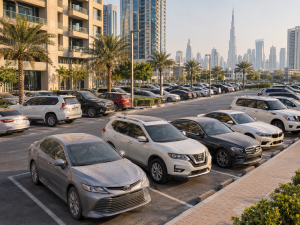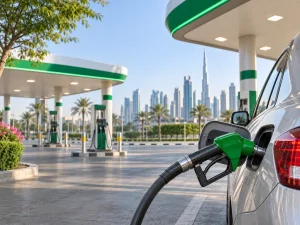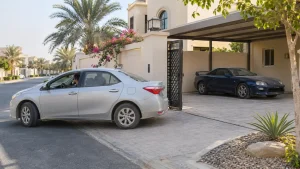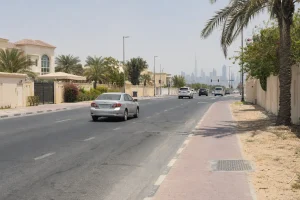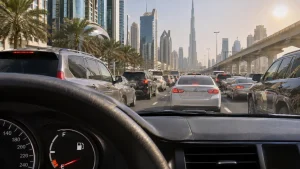
The villa was the easy decision. A place in Damac Hills 2, a garden, parking outside the door, and a rent that looked like a bargain next to a one-bedroom tower in Downtown. Then the first month happened. The commute was 28 kilometers each way, the school run added another loop, and the petrol gauge emptied in nine days.
Nobody had lied about the rent. They had never mentioned the car. If you live far from the centre of Dubai, the car is not an extra, it is the second rent. This guide prices it, using November 2026 fuel prices and published Dubai cost ranges. And when the maths catches you out, fuel delivery in Dubai brings petrol to wherever you are parked.
Why Living Far From the City Centre Looks Cheap Until the Car Bill Arrives
The trade is real, and it is the reason outer communities keep growing. Dubai South’s average new rent was about AED 135,100 a year in the three months to October 2026, according to Property Finder data reported by Dubai Fast Living. A three-bedroom villa in Damac Hills 2 is advertised from around AED 130,000 a year, per 2026 editorial estimates from Lived.ae. Compare that with a one-bedroom apartment in Downtown Dubai, where Bayut asking rents averaged about AED 111,000 a year in October 2026, and you can see the deal. Similar money, far more space, a garden instead of a balcony.
What the comparison leaves out is that the Downtown flat comes with a Metro station underneath it and the villa does not. In central Dubai, a car is a choice. In Dubai Silicon Oasis, Mirdif, Dubai South or Arabian Ranches 3, it is the only way the week works. The rent saving is genuine. The question is how much of it the car quietly takes back, every single month, in costs that never appear on a tenancy contract.
How Distance Changes the Cost of Running a Car in Dubai
Distance is the one number that drives the whole bill. Dubai Silicon Oasis sits 25–30 kilometres from Downtown Dubai, a 25–30 minute drive off-peak and 35–50 minutes in the morning rush. Mirdif has no metro station at all; the nearest, Centrepoint on the Red Line, is 8–12 minutes away by car. Oud Al Muteena is the same story, no station inside the community, with the nearest Green Line stops 10–13 minutes away by car. Buses exist, but they serve the edges, not the villa streets.
Take a typical outer-community commuter: home 28 kilometres from the office, five days a week. That is 56 kilometres a day, 1,232 kilometres a month just getting to work and back, before a single school run, grocery trip or weekend drive. Add a realistic 450 kilometres of everything else and the car is covering about 1,700 kilometres a month. A driver living in Business Bay and working in DIFC might do half that. Same car, same city — double the distance, because of where the front door is.
Fuel Costs in Dubai: The Bill That Grows With Every Kilometre
Fuel is the most visible part of the cost, and in November 2026 the numbers are straightforward. The UAE Fuel Price Committee set Super 98 at AED 4.16 a litre, Special 95 at AED 4.04 and E-Plus 91 at AED 3.97, effective 1 November 2026. Every grade fell 24 fils from October, and the price is identical at every station in all seven emirates. It changes on the first of every month, so treat these as the current month’s rates, not permanent ones.
Here is what that means for the 1,700-kilometre month above, using Special 95:
The arithmetic is simple and it is the point of the article: the outer-community sedan pays roughly double the fuel bill of the central driver in the same car, and the SUV pays more than two and a half times. Air conditioning widens the gap further in summer, because a car that spends its day parked in direct sun needs a hard cooling effort on every single trip. And if traffic is part of the commute, the stop-start penalty stacks on top, our guide on does Dubai traffic increase fuel consumption explains why the same route can cost noticeably more petrol in a congested week than in a free-flowing one.
The Full Monthly Cost of Running a Car in Dubai
Fuel is only the first line. Here is a realistic monthly build-up for that outer-community sedan, using published Dubai ranges and the assumptions stated above:
That figure lands squarely inside the published range: dxbtalk.com puts running a modest car in Dubai at AED 900–2,200 a month before any loan or purchase price. But notice how quickly it climbs. Put the same car on a route with four peak Salik crossings a day about AED 554 a month on its own, add premium office parking at roughly AED 50 a day, and the monthly bill passes AED 2,000 without the car doing anything unusual. Salik is the most route-sensitive cost in Dubai: some outer-community commutes via Sheikh Mohammed Bin Zayed Road cross no gates at all, while others cross two in each direction. Your exact route decides which end of the range you live in.
Car Depreciation in Dubai: The Cost Nobody Budgets
Every figure above is cash leaving your account. The biggest cost of running a car in Dubai never appears in a monthly budget at all, because it arrives silently: depreciation. Published Dubai guides put first-year depreciation at 15–25% of the car’s value, then 10–20% a year after that. On an AED 80,000 car, 15% is AED 12,000 a year, AED 1,000 a month of value evaporating, on top of the AED 1,160 a month in running costs above. That takes the true economic cost of the outer-community sedan to roughly AED 2,160 a month, or about AED 25,900 a year, before a single loan payment.
This matters most for the outer-community decision, because distance accelerates it. Higher annual mileage pushes resale value down faster, and a car bought for the villa years is worth noticeably less when the family moves on. It is not a reason to avoid the move, it is a reason to price the car honestly alongside the rent, rather than discovering it three years later at trade-in time.
Dubai Metro vs Car: Why the Metro Often Cannot Help Outer Communities
For comparison, a Metro commuter on a Silver nol card pays AED 3, AED 5 or AED 7.50 per trip depending on zones, with a daily cap of AED 14 roughly AED 130–310 a month pay-as-you-go, or AED 350 for an all-zones monthly pass. Against a car bill of AED 1,160 a month before depreciation, the Metro wins by a wide margin wherever the stations line up.
But that is exactly the problem for outer communities. Mirdif has no station. Oud Al Muteena has none inside the area. Dubai Silicon Oasis is served by a single bus route and feeder services, not a Metro line. A family in one of these communities cannot simply swap the car for a nol card; the public transport alternative is a drive to the station, a park, and a ride which still needs the car. The honest comparison is not car versus Metro. It is car versus car, and the outer-community car costs more because it drives further, every single day.
How to Reduce the Cost of Running a Car in Dubai
You cannot move the villa closer to the office, but you can control most of the bill’s moving parts:
Choose the route, not just the road. Salik gates are the most route-sensitive cost in Dubai. A route via Sheikh Mohammed Bin Zayed Road can avoid gates entirely on some outer-community commutes, while Sheikh Zayed Road adds them. Test both routes for a week and compare the Salik deductions, not just the drive time.
Measure your real consumption. Fill the tank fully, reset the trip meter, drive normally, refill fully and divide kilometers by liters. Do it over several refills. If your figure has jumped suddenly and stayed high even on open roads, something else is wrong, our guide on why your car is suddenly using more petrol walks through the checks, from tyre pressure to a dirty air filter.
Tame the air conditioning. The biggest avoidable fuel waste in an outer-community car is cooling a sunbaked cabin, several times a day, on short trips. Park in shade where you can, use a sunshade, ventilate the hot air for a few seconds before switching the AC on, and avoid long stationary idling with the AC at full blast.
Combine the short trips. Several short, traffic-heavy trips with parking in between mean repeated cold starts and repeated cabin cooling. One combined trip usually uses less petrol than the same stops made separately and in an outer community, where every errand is a drive, the saving adds up.
Keep the tyres right and the car serviced. Under-inflated tyres raise rolling resistance and make the engine work harder in exactly the slow, repeated-acceleration conditions where traffic already hurts. A quick pressure check is one of the cheapest fuel-saving habits in Dubai heat, and a missed service can quietly cost more in fuel than the service itself.
Running Out of Petrol Far From the City Centre: What to Do
Outer communities have one more quirk: the nearest petrol station is rarely around the corner. A driver in Downtown can coast to a station in minutes; a driver in Dubai South or Damac Hills 2 can be a long way from the nearest pump when the warning light comes on and running the tank low in summer heat, far from help, is exactly when a small problem becomes a tow truck. Fuel Delivery covers every community in Dubai, 24/7, with all three petrol grades and a full top-up, not just enough to limp to a station. The service charge is AED 150 plus the fuel price, and the number is +971 521679495. It is the safety net for the distance the villa adds to your week.
The Bottom Line: The Real Cost of Running a Car in Dubai
Living far from the city center in Dubai is a good deal for many families more space for similar money, a garden, a quieter street. But the deal has a second price, and it is the car. A realistic outer-community sedan costs roughly AED 1,160 a month to run before any loan, and roughly AED 2,160 a month once depreciation is counted. The fuel alone is about double what the same car costs a central driver. None of that makes the move wrong. It makes the move worth pricing properly: add the car bill to the rent saving, check your route’s Salik gates, measure your real consumption, and the villa decision becomes a decision made with the full picture not a surprise discovered one petrol gauge at a time.
Frequently Asked Questions
How much does it cost to run a car in Dubai per month?
Running a modest car in Dubai typically costs AED 900–2,200 a month before any loan payment or purchase price, according to published 2026 cost guides. An outer-community driver doing around 1,700 km a month can expect roughly AED 1,160 a month in fuel, insurance, tolls, parking, maintenance and registration, and roughly AED 2,160 a month once depreciation is included.
How much is petrol in Dubai in November 2026?
The UAE Fuel Price Committee set November 2026 prices at AED 4.16 a liter for Super 98, AED 4.04 for Special 95, AED 3.97 for E-Plus 91 and AED 4.75 for diesel, effective 1 November 2026. Prices are reviewed monthly and are the same at every station in all seven emirates.
Does living far from the city centre really double fuel costs?
It can. A compact sedan doing 1,700 km a month uses about 136 liters of Special 95, roughly AED 550 at November 2026 prices. The same car doing 800 km a month in the center uses about 64 liters, roughly AED 259. Distance is the main driver, the further the commute, the more liters, whatever the car.
Is it cheaper to live in the centre and use the Metro instead?
On transport alone, yes, a Metro all-zones pass is AED 350 a month against a car bill of AED 1,160 or more. But the comparison only works where the Metro reaches. Outer communities like Midriff and Oud Al Mutein have no station inside the area, so the car is usually not optional there, and the rent saving has to be weighed against the car bill rather than against a Metro fare.
What is the biggest hidden cost of running a car in Dubai?
Depreciation. Published guides put first-year value loss at 15–25%, then 10–20% a year. On an AED 80,000 car that is about AED 1,000 a month in the first year nearly as much as the fuel bill and higher annual mileage in an outer community pushes resale value down faster.