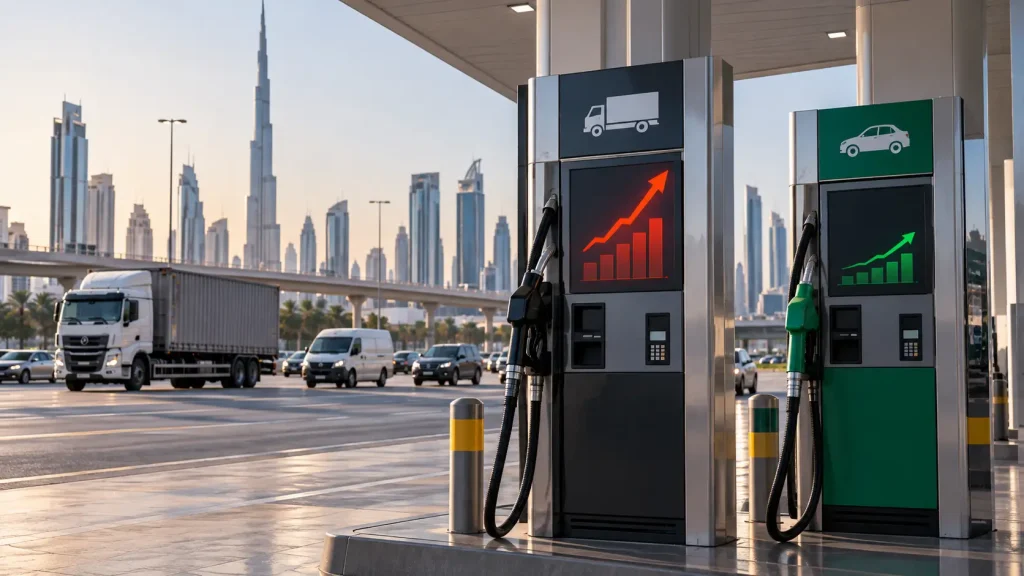
In September 2026, the UAE Fuel Price Committee’s monthly rate sheet showed something unusual: diesel prices rose 13.2%, while petrol rose only 5.6%. Both fuels are refined from the same crude oil, yet one moved more than double the rate of the other in a single month. For Dubai’s fleet operators and delivery businesses, that gap wasn’t a rounding quirk it reflected a genuine, data-backed split in global fuel markets, one that has direct implications for anyone managing diesel-dependent operations or arranging fuel delivery in Dubai rather than relying on unpredictable pump prices.
That divergence has a real, verifiable answer, and it has very little to do with Dubai itself.
The Numbers That Caught Dubai Drivers by Surprise
The UAE Fuel Price Committee announced new rates effective September 1, 2026, comparing them against August 2026 prices.
| Fuel Type | August 2026 | September 2026 | Change | % Change |
|---|---|---|---|---|
| Super 98 | AED 3.60 | AED 3.80 | +AED 0.20 | 5.56% |
| Special 95 | AED 3.49 | AED 3.69 | +AED 0.20 | 5.73% |
| E-Plus 91 | AED 3.41 | AED 3.61 | +AED 0.20 | 5.87% |
| Diesel | AED 3.80 | AED 4.30 | +AED 0.50 | 13.16% |
The “5.6%” in this article’s title refers to Super 98, the smallest of the three petrol increases. Diesel’s 13.16% rounds to the 13.2% widely reported locally. Every petrol grade moved by the same flat AED 0.20 diesel moved by AED 0.50, more than double the percentage increase. That gap is what caught drivers and fleet operators off guard, since petrol and diesel had typically moved by similar amounts in previous months.
If Both Come From Crude Oil, Why Didn’t Petrol and Diesel Rise Together?
Every drop of both fuels starts as crude oil, but crude isn’t sold at the pump; it’s refined first, splitting one barrel into petrol, diesel, jet fuel, and other products. Each refined product then trades in its own separate market, with its own buyers and supply conditions. Petrol is bought mostly by everyday drivers; diesel is bought by trucking companies, shipping lines, construction firms, and industrial users. Because they trade separately, their prices regularly move at different speeds September 2026 was simply a month where that gap widened sharply.
Why the Diesel Price UAE Can Move Differently From Petrol
The diesel price UAE sees at the pump reflects international diesel market pricing, not the general oil price. When diesel supply tightens specifically without the same happening to petrol, diesel can rise on its own, driven by different users, different global supply chains, and a separate international benchmark. In September 2026, all three pointed the same direction, as the next section explains.
Diesel Is More Closely Tied to the Global Economy Than Many Drivers Realize
Petrol mostly moves passenger cars. Diesel moves the physical economy trucks, freight vessels, construction equipment, and commercial fleets worldwide. Dubai’s large logistics, delivery, and construction sectors depend on diesel daily, so a diesel spike lands hardest on businesses, filtering into freight rates and delivery charges in the months after.
What Actually Happened in the Global Energy Market During This Period?
Through August and September 2026, the global diesel market entered a genuine supply crunch, separate from the general oil market:
- Persian Gulf conflict: over six months of regional war disrupted Middle East refining and export capacity around the Strait of Hormuz; Brent crude climbed back above $90 a barrel in early September after U.S.-Iran strikes and retaliation.
- Russian refinery strikes: Ukrainian drone attacks knocked out significant Russian processing capacity, prompting Moscow to extend its diesel export ban, removing barrels from a market Russia normally supplies heavily.
- Kuwaiti and Saudi outages: Kuwait’s Al Zour refinery had shipped almost no fuel oil since March; Saudi Arabia’s Jazan refinery, shut since late July, was struck again in early September.
- Global capacity shortfall: industry executives estimated the combined conflicts had taken roughly 5 million barrels a day of refining capacity offline worldwide.
These are confirmed developments, not background theory analysts at ING and other commodity desks noted diesel benchmarks had run roughly twice as fast as crude oil since the regional war began, the clearest sign this was a diesel-specific event.
The Global Diesel Market Can Tighten Faster Than the Petrol Market
Diesel has less of a safety buffer than petrol. Global distillate inventories were running well below their five-year average through this period, leaving little spare supply to absorb the disruptions above. Refiners in several regions had also shifted output toward jet fuel earlier in the year when aviation margins were stronger, leaving less capacity dedicated to diesel just as demand rose, the combination that let diesel prices outrun petrol.
Refinery Capacity Plays a Bigger Role Than Most People Think
Why Refineries Can’t Simply Produce Unlimited Diesel
A refinery processes each barrel into a fixed mix of outputs set largely by its design; it can’t simply “switch” to more diesel overnight, even as diesel prices rise faster than petrol’s.
How Refinery Disruptions Affect Diesel Prices
When capacity is lost as it was in Russia and the Gulf the product in shortest supply relative to demand sees the sharpest price response. In September 2026, that product was diesel, a specific, confirmed connection reported for this exact period, not a generic assumption.
Why Petrol Rose Too Just Not as Dramatically
Petrol didn’t stay flat: every grade rose 5.56–5.87%, tracking the same crude oil move that pushed diesel higher. But petrol didn’t face the same product-specific supply shock; global gasoline supply wasn’t hit by the same refinery outages, and petrol demand lacks diesel’s seasonal commercial surge. Petrol rose with the broader oil market; diesel rose with the market plus its own supply crisis on top.
How the UAE’s Monthly Fuel Pricing System Turned Global Changes Into a Dubai Price Increase
The UAE Fuel Price Committee reviews and adjusts fuel rates each month based on prevailing global energy-market conditions. That monthly mechanism is what connects international events, such as refinery disruptions in Kuwait, to the price businesses ultimately pay for diesel. The full 2026 fuel-price data trail puts September’s diesel increase into the wider context of how petrol and diesel prices moved throughout the year. September’s spike, however, was driven by diesel-specific pressures in global refined-fuel markets rather than by crude oil prices alone.
Why the 13.2% Diesel Increase Matters More for Dubai Businesses
For an individual driver, a 5.6% petrol increase is a manageable monthly adjustment. For a business running diesel vehicles at scale, the math changes quickly.
(The following are illustrative examples only, based on the AED 0.50 per litre increase.)
- 100 litres of diesel a week: AED 50 more per week, or roughly AED 2,600 more per year
- 500 litres of diesel a week: (a small delivery fleet, similar to Yusuf’s): AED 250 more per week, or roughly AED 13,000 more per year
- 1,000 litres of diesel a week: (a mid-sized logistics or construction operation): AED 500 more per week, or roughly AED 26,000 more per year
These figures scale linearly with the AED 0.50 per litre increase and don’t account for other operating cost changes; they’re meant to illustrate scale, not serve as a forecast.
What This Means for Diesel Vehicle Owners
A 70-litre diesel tank cost about AED 266 in August; at September’s rate it costs about AED 301 roughly AED 35 more per fill-up, or about AED 70 a month for someone filling twice monthly. Noticeable, but far less dramatic than the impact on businesses filling hundreds or thousands of litres weekly.
Could Diesel Keep Rising Faster Than Petrol?
One month’s data doesn’t establish a trend. It depends on whether Gulf tensions ease, damaged Russian refineries return online, refiners shift output back toward diesel, and how distillate inventories move. Analysts have suggested diesel markets could stay tight “for months” an outlook, not a certainty.
What Drivers and Businesses Can Do
Individual drivers: watch the monthly price announcement, reduce idling, keep tyres properly inflated, stay current on maintenance, and combine errands into fewer trips.
Fleets and businesses: track fuel consumption per vehicle, optimize routes, monitor underperforming vehicles, and plan refuelling ahead of time which also cuts time lost to petrol station queues during Dubai rush hour, time that adds up fast across a multi-vehicle fleet.
FAQs
Why did diesel increase more than petrol in the UAE?
Diesel faced a global supply-specific crunch in August–September 2026 refinery outages in Russia, Kuwait, and Saudi Arabia, a Russian export ban, and ongoing Gulf conflict that petrol didn’t face to the same extent.
What is the current diesel price in UAE?
As of September 1, 2026, diesel is AED 4.30 per litre, up from AED 3.80 in August.
Why do petrol and diesel prices move differently?
They’re refined from the same crude but sold in separate markets with different buyers and supply conditions, so prices often move at different speeds.
Are fuel prices the same across Dubai and the UAE?
Yes the UAE Fuel Price Committee sets one set of rates applying across all seven emirates.
Will diesel prices continue to increase?
Uncertain it depends on how the Gulf conflict, Russian refinery repairs, and global distillate inventories develop. One sharp month doesn’t guarantee a continuing trend.
Conclusion
Petrol and diesel both start as crude oil, but September 2026 was a clear reminder that they don’t move together once real-world disruptions hit a diesel-specific supply crunch pushed diesel up 13.2% while petrol rose a comparatively modest 5.6%, and that gap is exactly the kind of unpredictable cost swing that makes reliable fuel delivery in Dubai worth having on your side, whether you’re managing one diesel van or an entire fleet. If you’d rather not be caught off guard by the next price announcement, get in touch with our team to see how scheduled or on-demand delivery can help you plan around exactly this kind of volatility.