You filled up in February and it cost one thing. You filled up this month and it cost nearly twice as much. Nothing about your car changed, and you are not imagining it.
UAE petrol has risen for three months straight, and October’s rates are the highest of 2026. That makes this a good moment to understand what your car is actually consuming, what it is costing you over a year, and which changes genuinely move the number.
We spend our days running fuel delivery in Dubai, which means we see a lot of fuel gauges and hear a lot of versions of the same question: where is it all going? Here is the honest answer.
What Petrol Costs in Dubai right now
UAE fuel prices are set nationally by the Gasoline and Diesel Prices Follow-up Committee and updated on the first of every month. They are identical in Dubai, Abu Dhabi, Sharjah and every other emirate.
October 2026 rates:
| Grade | Price per litre | September | Change |
|---|---|---|---|
| Super 98 | AED 4.40 | AED 3.80 | +60 fils |
| Special 95 | AED 4.28 | AED 3.69 | +59 fils |
| E-Plus 91 | AED 4.21 | AED 3.61 | +60 fils |
| Diesel | AED 4.80 | AED 4.30 | +50 fils |
That is the third consecutive monthly increase, and the highest petrol has been this year. For context, a 60-litre tank of Special 95 now costs about AED 257, against roughly AED 221 in September.
Because rates reset monthly, the figures below use October’s Special 95 price. The method works whatever next month brings swap in the current rate.
What Your Consumption Actually Costs Over a Year
This is the number most drivers have never worked out. At 15,000 km a year on Special 95 at AED 4.28:
| Your consumption | Litres per year | Annual fuel cost |
|---|---|---|
| 7 L/100km (small hatchback) | 1,050 | AED 4,494 |
| 9 L/100km (mid-size sedan) | 1,350 | AED 5,778 |
| 11 L/100km (crossover) | 1,650 | AED 7,062 |
| 14 L/100km (large SUV) | 2,100 | AED 8,988 |
| 18 L/100km (V8 SUV) | 2,700 | AED 11,556 |
The gap between a sedan and a large SUV is around AED 3,200 a year at current prices. And a 10% improvement on an 11 L/100km car is roughly AED 700 a year which is what makes the rest of this article worth ten minutes.
To find your own figure: divide your annual kilometres by 100, multiply by your consumption, multiply by the current price per litre.
Why Dubai is Harder on Fuel Economy Than Most Places
Your car will almost never match its brochure figure here, and that is not the car’s fault.
Air conditioning runs most of the year: The compressor draws power from the engine, and in a Dubai summer it is working against cabin temperatures that can exceed 60 °C after a few hours parked. This is the single largest climate-driven difference between UAE consumption and the manufacturer’s test figures.
Stop-start traffic: Every time you accelerate from a standstill you use far more fuel than cruising. Sheikh Zayed Road at eight in the morning is close to a worst case.
High cruising speeds: Aerodynamic drag rises sharply with speed. A car that returns its best figure at 80 km/h will do noticeably worse at 120 km/h, and UAE highway limits encourage the latter.
Short trips: An engine uses more fuel until it reaches operating temperature. A five-minute drive to the shops is consumed almost entirely in that inefficient window.
Dust: Fine desert dust clogs air filters faster here than in most markets, and a restricted filter makes the engine work harder.
Idling: Sitting in a parked car with the engine running for the AC is normal in Dubai and burns fuel at zero kilometres per litre.
The Causes You Control
In rough order of how much they matter:
Driving style: Hard acceleration and late braking are the biggest single variable. Smooth inputs and anticipating the traffic ahead make a larger difference than any accessory or additive.
Speed on the highway: Holding a steady 100–110 km/h instead of 130 km/h produces a genuinely noticeable saving on a long run, because drag increases with the square of speed.
Idling: If you are waiting more than a minute or two, switching off is cheaper than idling unless you are in traffic that is about to move.
Weight and drag: Roof boxes and roof racks hurt economy badly at highway speed. Take them off when they are not in use. Clearing out an unnecessarily loaded boot helps a little.
Tyre pressure: Underinflated tyres increase rolling resistance. Check monthly, when the tyres are cold, against the figure on the driver’s door jamb not the number on the tyre sidewall, which is a maximum rather than a recommendation.
Air conditioning use: The practical rule: at low city speeds, open windows cost less than AC. At highway speed, the aerodynamic drag of open windows costs more than running the AC. In a Dubai summer, comfort and safety come first either way park in shade where you can, and use the windows to vent the worst of the heat before you set off rather than asking the AC to do all of it.
The mechanical causes worth checking
If your economy has been drifting worse over months rather than changing overnight:
- Clogged air filter: The most common and cheapest fix in this climate
- Worn spark plugs: Incomplete combustion wastes fuel
- Failing oxygen sensor: Causes the engine to run richer than it needs to
- Dragging brakes or seized caliper: The car is fighting itself
- Wheel misalignment: Increases rolling resistance, and Dubai’s speed bumps cause plenty of it
- Old or incorrect engine oil: The wrong grade increases internal friction
If the change was sudden rather than gradual, that points to a specific fault rather than normal wear. Our guide to why your car is suddenly using more petrol than before covers that diagnosis in detail.
Does higher-octane petrol improve fuel economy?
This is the most expensive misunderstanding in the Dubai market.
Octane rating measures resistance to pre-ignition, not energy content. Running Super 98 in a car designed for Special 95 does not deliver more kilometers per litre, it just costs 12 fills more per liter, which on 1,650 liters a year is about AED 200 for nothing.
The reverse matters more. If your manufacturer specifies a higher grade common on turbocharged and performance engines using a lower one can cause the engine management to retard ignition timing, which reduces both performance and economy.
Use the grade in your owner’s manual. Not higher, not lower. We explore this further in does premium petrol actually improve your car’s performance, and you can order whichever grade your car takes Special 95, Super 98 or E-Plus 91 delivered to your location.
Seven changes that actually move the number
- Ease off the accelerator and anticipate the traffic ahead
- Hold a steadier, lower speed on the highway
- Check tyre pressures once a month, cold
- Replace the air filter on schedule, or sooner in dusty conditions
- Take the roof box off when you are not using it
- Park in shade so the AC starts from a lower cabin temperature
- Combine errands into one longer trip rather than several short cold starts
None of these requires a product, an additive or a workshop visit.
The Cost That is not in the Price Per Litre
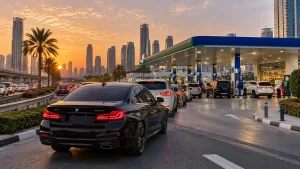
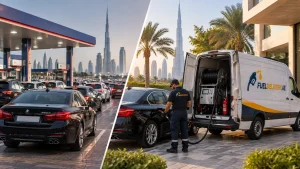
There is one more line in the arithmetic that almost nobody counts. Getting fuel costs you the fuel, plus the detour to the station, plus the queue, plus the engine idling while you wait. In Dubai traffic, that is routinely 15 to 25 minutes, and the detour itself burns fuel at the worst possible efficiency short, stop-start, often with the AC running.
For a lot of drivers, particularly those who fill up two or three times a month, that adds up to several hours a year spent not driving anywhere.
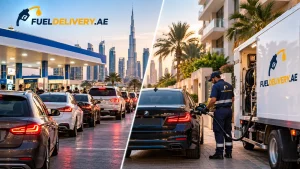
That is the part our service removes. Petrol delivery in Dubai brings the fuel to your car at home, at the office, or wherever you are parked so the only cost is the fuel itself, plus a flat AED 150 service charge. No detour, no queue, no idling.
Frequently Asked Questions
How much petrol does the AC use?
Enough to be your largest climate-related cost, though the exact figure depends on the car, the cabin temperature and your speed. It is most costly in slow traffic and least costly at a steady highway cruise.
Is it cheaper to drive with the windows down?
At low city speeds, usually yes. At highway speeds, no the extra aerodynamic drag outweighs the AC load. In UAE summer heat, comfort and alertness matter more than the difference.
Does a fuller tank use more fuel because of the weight?
The effect is real but very small. A full 60-litre tank adds roughly 45 kg, which is less than a passenger. It is not a reason to run the tank low and running low has real costs of its own.
Will fuel additives improve my economy?
A genuine injector cleaner can help an engine with fouled injectors return to its normal consumption. It will not take a healthy engine below its design figure. Treat large claims sceptically.
Why is my economy worse in summer?
Sustained AC load, higher under-bonnet temperatures and more idling in parked cars. A seasonal swing is normal in the UAE.
Do petrol prices differ between Dubai and the other emirates?
No. The Gasoline and Diesel Prices Follow-up Committee sets one national rate, updated on the first of each month.
Cut the fuel you waste, and the trip to get it
Most of what improves fuel economy is free: smoother inputs, correct tyre pressures, a clean air filter and the right grade of petrol. Working out your own annual figure from the table above usually provides the motivation.
And when the tank does need filling, you do not have to spend twenty minutes of your day on it. We deliver Special 95, Super 98 and E-Plus 91 across every area of Dubai, 24/7, at your home, office or roadside.