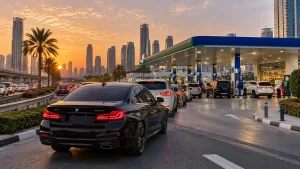
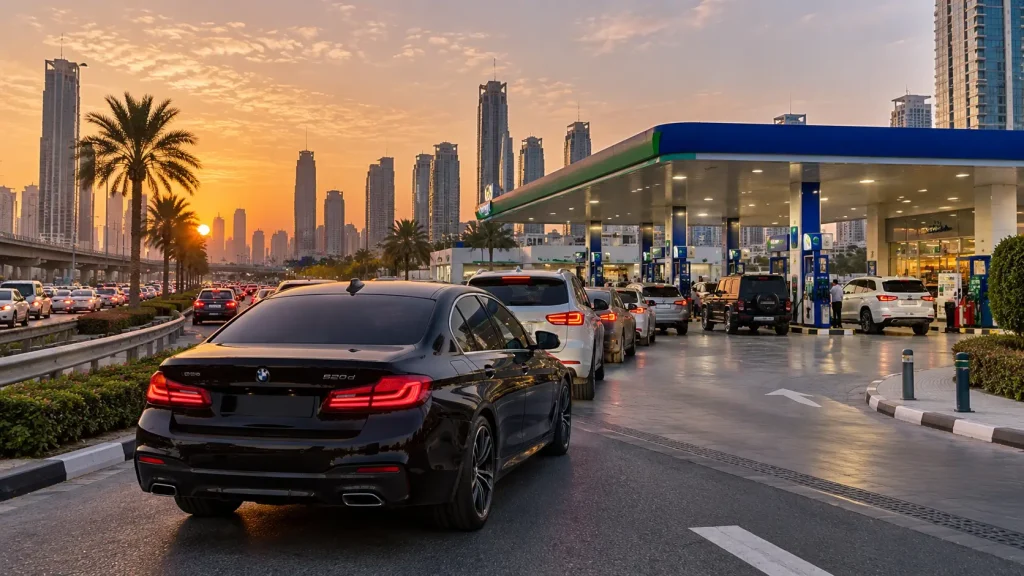
Black BMW waiting in traffic at a busy petrol station in Dubai during evening rush hour

12 Minutes or 25? How Long Does a Dubai Petrol Stop Take?

How long does a petrol station visit in Dubai actually take 12 minutes or 25? At around 6:15pm, a driver leaving Al Quoz notices the fuel gauge has fallen to a quarter tank. The nearest station looks close enough for a quick stop, but the evening traffic tells a different story. What appears to be a simple few-minute detour can involve slower roads, a longer route and time spent getting back into traffic. For drivers considering fuel delivery in Dubai, that raises a more useful question: what is the real petrol station visit time in Dubai once the entire journey is counted?TomTom’s 2025 Traffic Index gives us a starting point for answering that question. Across Dubai, a typical 10-kilometre journey took 19 minutes and 10 seconds, while the same distance during evening rush hour increased to 26 minutes and 33 seconds. That figure does not represent the time spent at a fuel pump or in a station queue. Instead, it shows how much the journey to and from a station can change depending on traffic conditions.

What Does Petrol Station Visit Time Really Mean?

When drivers think about refueling, they usually focus on the few minutes spent beside the pump. But the actual visit starts before the car enters the station and ends only after it returns to its route. A realistic calculation therefore includes the drive to the station, any delay entering the forecourt, waiting for a pump, refueling, payment and the journey back onto the original road.That is why there is no single petrol station visit time in Dubai that applies to everyone. A driver stopping at a quiet station in the middle of the afternoon can have a completely different experience from someone making the same stop during the evening rush. The station itself may take only a few minutes, while traffic around it can determine how long the overall interruption becomes.

Why Dubai Traffic Changes a Simple Fuel Stop

The biggest variable is often not the pump but the road. TomTom recorded an average evening rush-hour speed of 22.6 km/h in Dubai during 2025, compared with 32.1 km/h during the morning rush hour. A 10-kilometre journey consequently took 26 minutes and 33 seconds in the evening rush, compared with 18 minutes and 41 seconds in the morning.For a driver who needs fuel after work, those numbers put the idea of a “quick stop” into perspective. A station might be geographically close, but if the surrounding roads are moving slowly, the travel portion of the visit can consume much more time than expected. The difference becomes even more noticeable when the driver has to leave the main route and later rejoin it.

The Journey to the Pump Is Part of the Cost

The time spent travelling to a station is only one part of the calculation. A detour also means the vehicle travels additional kilometres, which consumes additional fuel. For drivers comparing a station visit with petrol delivery in Dubai, that extra travel becomes an important part of the overall cost. The exact amount depends on the vehicle, the distance and the route, so it would be misleading to assign one universal cost to every driver.Time has a similar variable value. For a private driver, an extra 10 or 15 minutes may mean arriving home later or delaying another appointment. For a delivery vehicle or business fleet, those same minutes can also represent time away from productive work. The point is not that every station visit is expensive, but that the cost can be measured more completely than simply looking at the petrol receipt.

Why 12 Minutes and 25 Minutes Can Both Be Real

A 12-minute stop is entirely possible under the right conditions. If the station is close, traffic is light, a pump is immediately available and the driver completes the transaction quickly, the entire visit can remain relatively short.The same station can produce a very different result during a busy period. The road journey can take longer, the station may have more vehicles waiting and returning to the original route can add another delay. This is why a fixed number such as 12 minutes should not be treated as a universal Dubai average.TomTom’s data supports the broader point without claiming to measure station queues. Its 2025 Dubai figures show that the road component alone can increase substantially during peak periods.

How Often You Refuel Matters Too

The effect becomes more meaningful when the same trip is repeated throughout the month. A driver who fills the tank twice a month makes roughly two station journeys, while someone who regularly makes smaller top-ups may visit much more frequently.The price per litre does not become higher because of those additional visits. What changes is the amount of travel and time attached to buying the same fuel over the course of the year. A few extra minutes on one visit may seem insignificant, but repeated across dozens of trips, the accumulated time becomes easier to identify.This is also why comparing one station visit can produce a very different picture from comparing a full year of refueling.

Where Does Fuel Delivery Enter the Calculation?

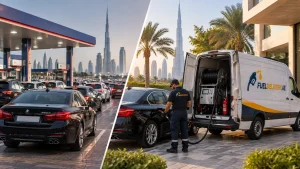
Once the travel component is separated from the petrol itself, the comparison with fuel delivery becomes easier to understand. A conventional station visit requires the driver to travel to the fuel, while mobile delivery brings the fuel to the vehicle. The fuel remains the main purchase in both cases, but the surrounding costs are different.The comparison can therefore be expressed simply: station refueling adds travel and time to the fuel cost, while delivery adds a delivery charge instead. Which option makes more financial sense depends on the driver’s distance from a station, traffic conditions, refueling frequency and the value of the time involved. There is no single break-even point that applies to every Dubai driver.

The Traffic Data in the Bigger Fuel-Cost Picture

Dubai’s traffic is only one part of the wider refueling equation. The full 2026 fuel-price data trail shows how petrol and diesel prices themselves have changed throughout the year. This cluster looks at a different variable: the time and travel involved in physically reaching the fuel.Together, these figures show why the price displayed at the pump should not always be treated as the complete cost of a refueling trip. The fuel itself may be the largest expense, but the journey required to purchase it can also create recurring costs for drivers who refuel frequently.

What Does Dubai’s Traffic Index Really Tell Us?

The most useful conclusion is not that every petrol station visit takes 12 minutes or that every evening stop takes 25 minutes. The data shows something more practical: the time required to reach fuel changes considerably with traffic conditions.In 2025, Dubai’s average 10-kilometre journey took 19 minutes and 10 seconds, while evening rush-hour travel for the same distance averaged 26 minutes and 33 seconds. TomTom also estimated that Dubai drivers lost 72 hours to traffic during rush hours across the year.For anyone calculating their actual petrol station visit time in Dubai, the useful approach is therefore to look at the complete journey rather than the pump alone. Measure the detour, consider the time of day, account for the station stop and then look at how often the trip is repeated.

Frequently Asked Questions

How long does a petrol station visit take in Dubai?There is no fixed average for every station. The total time depends on the distance, traffic conditions, station activity, queue and refueling time.How long does a 10-kilometre journey take in Dubai?TomTom recorded an average of 19 minutes and 10 seconds in 2025, rising to 26 minutes and 33 seconds during evening rush hour.Does Dubai traffic increase the cost of refueling?It can. Longer journeys can mean additional fuel consumption and more time spent completing the station trip.Does fuel delivery remove the journey to the station?Yes, mobile delivery removes the need for the driver to travel to a petrol station, although delivery involves its own charges and service conditions.Why does refueling frequency matter?Because the travel and time involved in a station visit are repeated every time the vehicle needs to return for fuel. More frequent visits can therefore increase the cumulative time attached to refueling.

Related Posts