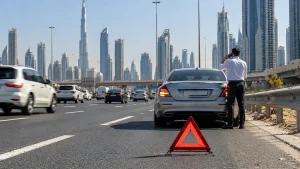
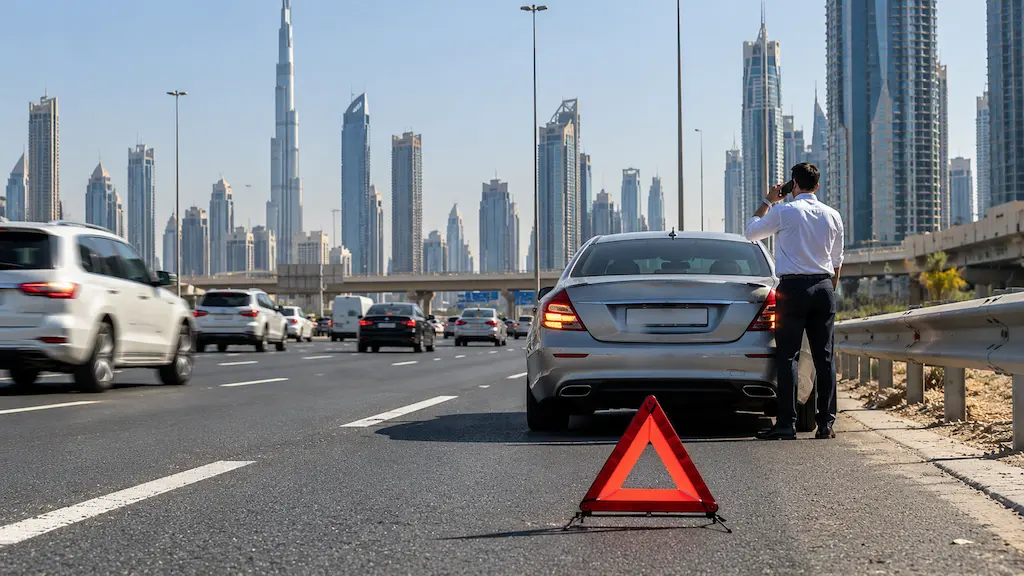
Imagine driving along Sheikh Zayed Road during Dubai’s evening rush hour. Your fuel warning light has been on for several kilometres, but you believe there is enough petrol to reach the next station.
Suddenly, the engine begins losing power. Within seconds, your car stalls in a live traffic lane, leaving approaching vehicles struggling to react. What started as a simple fuel shortage has become a serious road safety risk, potentially exposing you to AED 1,500 in traffic penalties and six black points.
For motorists concerned about running out of petrol, arranging fuel delivery in Dubai before the tank becomes empty can help avoid unnecessary roadside emergencies. But why can one mid-road breakdown lead to two separate fines? And does every driver whose car runs out of petrol automatically face an AED 1,500 penalty?
Understanding Dubai’s traffic rules can help you make safer decisions before a preventable breakdown becomes an expensive incident.
Can You Really Be Fined AED 1,500 for Stalling in the Middle of the Road?
Yes. A driver whose vehicle stops in the middle of a road in Dubai may face penalties totalling AED 1,500 and six black points when both the mid-road stopping and traffic obstruction violations apply.
Dubai Police reiterated these penalties in 2026 while warning motorists about the serious consequences of stopping unexpectedly in active traffic lanes. The important distinction is that the fine is not simply for having an empty fuel tank.
The penalties concern the dangerous situation created when a vehicle stops in the middle of the road and obstructs other road users.
Breaking down the two-charge penalty
| Traffic violation | Fine | Black points |
|---|---|---|
| Stopping in the middle of the road | AED 1,000 | 6 |
| Obstructing traffic flow under Article 98 | AED 500 | – |
| Potential combined penalty | AED 1,500 | 6 |
According to Dubai Police warnings reported by Khaleej Times on April 7, 2026, both penalties may apply when a vehicle stops mid-road and obstructs traffic.
Important: These are two distinct traffic violations. The combined amount should not be interpreted as an automatic fine imposed on every driver whose vehicle breaks down. Enforcement depends on the circumstances and applicable traffic rules.
Why Dubai Authorities Treat Mid-Road Stalling Seriously
A stationary vehicle in an active traffic lane is more than an inconvenience. On high-speed roads such as Sheikh Zayed Road, Al Khail Road, and Emirates Road, other motorists may have very little time to recognize and respond to an unexpected obstruction.
The risk becomes especially serious when:
- A vehicle stops suddenly without reaching a safe shoulder.
- Approaching drivers fail to notice the stationary car.
- Other vehicles brake abruptly or change lanes to avoid a collision.
- Traffic backs up around the obstruction.
- A driver or passenger attempts to walk through moving traffic.
Even a short interruption can create dangerous conditions on a busy highway.
Real case study: Three injured after a mid-road stop on Al Khail Road
On April 7, 2026, Gulf News and Khaleej Times reported a three-vehicle collision on Dubai’s Al Khail Road.
According to Dubai Police, the incident began when a motorist stopped in the middle of the road to retrieve a fallen number plate. An approaching vehicle struck the individual and became involved in a collision with other vehicles.
Three people were injured. Although this particular accident was not caused by an empty fuel tank, it demonstrates why Dubai Police warn against stopping in live traffic lanes for any reason.
The incident also illustrates an important lesson: retrieving an object, checking a vehicle, or attempting repairs in the middle of a road can create risks far greater than the original problem.
Another serious incident in Jebel Ali
On July 4, 2026, Emirates 24|7 reported that 25 people were injured in a collision involving four vehicles after a vehicle stopped in the middle of a road in Jebel Ali because of a technical failure.
Dubai Police again emphasized the AED 1,000 fine, six black points, and additional AED 500 traffic obstruction penalty.
These documented incidents underline why drivers should priorities reaching a safe location and requesting appropriate assistance rather than attempting to resolve a vehicle problem in an active traffic lane.
Does Running Out of Fuel Automatically Result in a Traffic Fine?
No. Running out of petrol and committing a mid-road stopping violation are not necessarily the same thing. A vehicle might run out of fuel while parked safely in a designated parking area. Another might lose power in an active highway lane, creating an immediate risk for surrounding traffic.
These situations have different safety implications.
| Situation | Potential consequence |
|---|---|
| Car runs out of fuel in a permitted parking space | No automatic mid-road stopping fine simply because the tank is empty |
| Car stops in a live traffic lane | AED 1,000 fine and six black points may apply |
| Stationary vehicle also obstructs traffic flow | An additional AED 500 penalty may apply |
| Vehicle breaks down and can be moved safely off the road | Move to safety and arrange appropriate assistance |
| Vehicle is immobilized in an unsafe location | Contact police immediately and follow emergency safety instructions |
The critical issue is where the vehicle stops, whether it obstructs traffic, and the circumstances surrounding the breakdown. This is why treating your fuel warning light as an early signal to act is more sensible than assuming you can reach one more petrol station.
The Warning Signs That Often Appear Before a Fuel-Related Breakdown
Most vehicles provide clear dashboard warnings before the fuel tank becomes critically low. However, drivers sometimes ignore those signals because they believe the remaining petrol will last longer than it actually does.
Watch for the following warning signs:
1. The low-fuel warning light stays on
The dashboard fuel symbol is one of the clearest indications that you should refuel soon.
It does not guarantee a fixed number of kilometres before the tank becomes empty.
2. The distance-to-empty reading falls rapidly
Modern vehicles estimate the remaining driving range based on fuel level and consumption.
Traffic congestion, acceleration, road conditions, and air conditioning usage can change the actual distance available.
3. The fuel gauge reaches empty
A fuel gauge approaching E indicates that the remaining fuel reserve is critically low.
Continuing to drive increases the possibility of an unexpected stop.
4. The engine begins hesitating or losing power
An engine that jerks, sputters, or loses power may be experiencing fuel starvation.
However, these symptoms can also indicate mechanical or electrical problems, so they should not automatically be attributed to an empty tank.
For a complete explanation, read our guide on running low on fuel and the warning signs your car needs refueling.
Recognizing these signs early gives drivers more time to reach an appropriate fuel station or arrange refueling at a suitable location.
What Should You Do If Your Car Starts Losing Power on a Dubai Road?
If your vehicle suddenly begins losing power, your priority should be avoiding a collision.
Step 1: Stay calm and activate your hazard lights
- Switch on your hazard warning lights to alert surrounding drivers.
- Avoid sudden braking or unpredictable steering.
Step 2: Move toward a safe stopping location if possible
- If the vehicle is still controllable, carefully move toward an appropriate shoulder, emergency stopping area, or safe exit.
- Do not attempt dangerous lane changes to reach a particular location.
Step 3: Do not stop to inspect the vehicle in a live lane
- Opening the bonnet, checking the fuel tank, or attempting a roadside repair while surrounded by moving traffic can expose you to serious danger.
- Do not walk across active lanes to reach a petrol station.
Step 4: Contact emergency assistance if the vehicle cannot be moved
- If your car becomes immobilized in a live traffic lane or another dangerous location, contact Dubai Police immediately.
- Use 999 for an emergency requiring police assistance. Explain your location, direction of travel, and the nature of the obstruction.
- Follow the instructions given by emergency personnel.
Step 5: Protect yourself and your passengers
- Where it is safe to exit, move to a protected location away from traffic. If leaving the vehicle would expose you to moving vehicles, do not attempt to cross lanes.
- Follow emergency services’ instructions.
- Place a warning triangle only when conditions allow you to do so safely.
Step 6: Arrange appropriate assistance
- Once the location has been secured, determine whether the vehicle requires towing, mechanical assistance, or refuelling.
- If the only problem is insufficient fuel and the location is suitable for service, mobile petrol delivery may provide a convenient solution.
Remember: Fuel delivery is not a replacement for police or roadside safety assistance when a vehicle is blocking a live highway lane.
Why an Empty Fuel Tank Can Become More Expensive Than the Fine
The potential AED 1,500 penalty is only one financial concern. A fuel-related breakdown may create additional expenses, particularly when it occurs in an unsafe location or the vehicle requires repairs.
Possible costs beyond traffic penalties
| Expense | Why it may occur |
|---|---|
| Vehicle recovery | Towing may be necessary if the vehicle cannot be safely refueled or restarted |
| Fuel-system inspection | A vehicle that repeatedly stalls may require diagnosis |
| Fuel pump repairs | Repeated fuel starvation can contribute to pump stress in some fuel-system designs |
| Missed commitments | A breakdown may interrupt work, appointments, or commercial deliveries |
| Accident-related expenses | A collision can lead to additional damage and financial consequences |
Not every breakdown results in these costs. However, the risks illustrate why preventive refueling is generally preferable to waiting until the engine stops.
How to Prevent Fuel-Related Stalling in Dubai
Avoiding an empty tank does not require complicated planning. A few driving habits can make a meaningful difference, particularly on longer routes and during heavy traffic.
Refuel before reaching the reserve level
A practical habit is to begin planning a refill when your tank approaches one-quarter full. This provides a buffer against unexpected congestion or route changes.
Check your fuel level before using major highways
Before entering Sheikh Zayed Road, Emirates Road, or other major routes, check whether you have enough petrol to complete your journey with a comfortable reserve.
Do not rely entirely on estimated fuel range
Your distance-to-empty display is an estimate, not a guarantee. Fuel consumption changes with driving conditions, vehicle load, and engine operation.
Pay attention to unusual fuel consumption
A vehicle using substantially more petrol than normal may need maintenance. Incorrect tyre pressure, engine problems, fuel-system faults, or changed driving patterns can affect fuel economy.
Arrange fuel delivery before an emergency develops
If your vehicle is parked safely at home, work, or another accessible location, arranging a refill in advance may help you avoid beginning a journey with critically low fuel. This is particularly useful for drivers with demanding schedules who may repeatedly postpone petrol station visits.
What Dubai’s AED 1,500 Mid-Road Penalty Teaches Drivers
Dubai’s roads depend on predictable traffic movement and safe driving behaviour.
The two-charge penalty reflects the serious consequences a stationary vehicle can create when it obstructs moving traffic.
Three lessons stand out:
First, an empty fuel tank is not automatically an AED 1,500 offence. The penalties concern stopping in the middle of the road and obstructing traffic.
Second, six black points can make a preventable stop more consequential. The financial penalty is not the only possible outcome.
Third, the safest response begins before the vehicle loses power. Checking the fuel gauge, recognizing warning signs, and refueling in time reduce avoidable risks.
The July 2026 Jebel Ali collision and April 2026 Al Khail Road incident demonstrate why Dubai Police continue to warn motorists about unexpected stops in active traffic lanes.
Frequently Asked Questions
1. What is the fine for stopping in the middle of the road in Dubai?
Stopping in the middle of the road can result in an AED 1,000 fine and six black points. An additional AED 500 fine for obstructing traffic may apply, bringing the combined penalties to AED 1,500.
2. Can I get fined for running out of petrol in Dubai?
Running out of petrol itself is not automatically an AED 1,500 offence. However, if your vehicle stops in the middle of the road or obstructs traffic, relevant traffic penalties may apply depending on the circumstances.
3. How many black points are issued for stopping mid-road?
The mid-road stopping violation carries six traffic black points, according to Dubai Police warnings reported in 2026.
4. What should I do if my car stalls on Sheikh Zayed Road?
Activate your hazard lights, move to a safe location if possible, and contact Dubai Police immediately if your vehicle remains immobilised in a dangerous position. Do not attempt to repair or refuel the vehicle in an active traffic lane.
5. Can fuel delivery reach my car if it runs out of petrol?
Fuel delivery may be available at suitable and accessible locations, subject to provider capabilities and safety restrictions. If your vehicle is obstructing a highway lane, emergency safety assistance and securing the location must come first.
6. How can I avoid a fine for stopping in the middle of the road?
Maintain your vehicle, monitor its fuel level, address warning signs early, and avoid beginning journeys with insufficient petrol. If a breakdown becomes unavoidable, follow road safety procedures and seek emergency assistance when necessary.
Conclusion:
A fuel warning light might seem like a minor inconvenience, but ignoring it until your vehicle stalls in moving traffic can have serious consequences. Dubai’s mid-road stopping rules allow for an AED 1,000 fine and six black points, with an additional AED 500 penalty for obstructing traffic when applicable.
More importantly, an unexpected stop on a busy road can put drivers, passengers, and other motorists at risk. Checking your fuel level before travelling, recognizing early warning signs, and arranging timely refueling through petrol delivery in Dubai can help prevent unnecessary roadside emergencies.
Before your next journey, make sure you have enough petrol to reach your destination safely. Choosing a convenient fuel delivery service while your vehicle is safely parked can save time and reduce the risk of running out of fuel on the road.