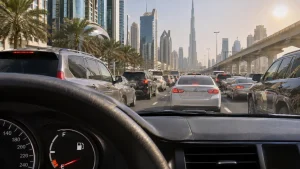
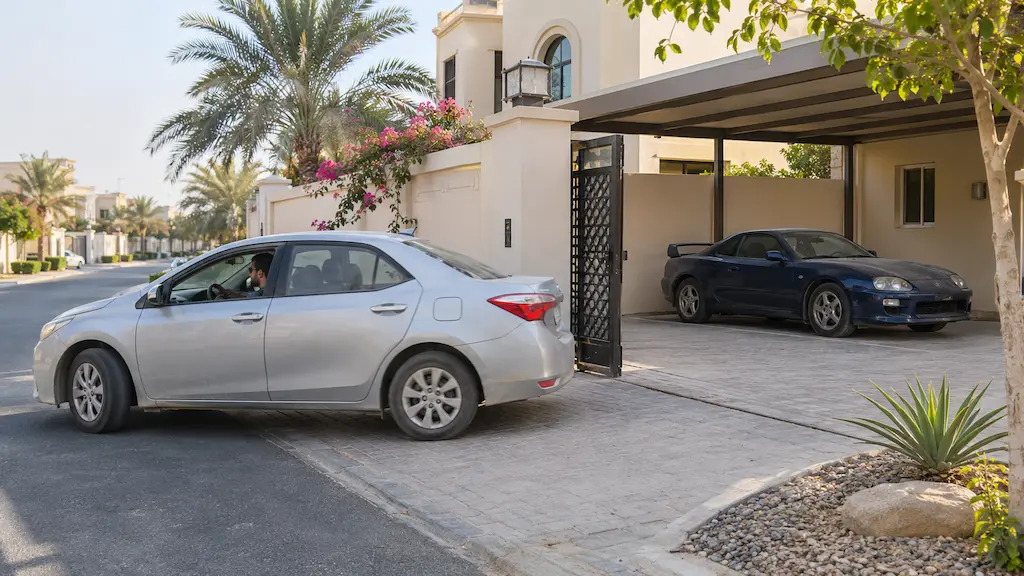
Two neighbors in the same Dubai community drive the same model of car. One fills up every four days, the other once a fortnight, and neither of them is doing anything wrong. The difference is not the car. It is the routine. One drives 40 kilometers a day through stop-start traffic with the air conditioning working hard, and the other drives twice a week to the shops and back.
The same liter of petrol behaves very differently in those two lives. This guide looks at what different driving routines cost in petrol, why the differences are so large, and how to match your filling habits to the way you drive. And if the tank ever runs dry, fuel delivery in Dubai brings petrol to you, wherever you are.
Why the Same Car Can Use Twice the Petrol
The car is only half the story. The routine decides how much of each liter becomes movement and how much becomes heat, idling and cold starts. The same car that returns about 20 km/L on an open motorway can return only 12 to 13 km/L in dense city traffic, a drop of 35 to 40 percent, with nothing wrong with the car at all. Where you live plays into it too, because it decides how far you drive and what kind of roads you drive on, as our guide to how where you live in Dubai changes how you use petrol explains. Five things drive the difference:
- Cold starts: a cold engine runs on a richer fuel mixture until it reaches operating temperature, usually after 3 to 5 km of driving.
- Stop-start traffic: accelerating a heavy car from a standstill is the thirstiest moment in any journey, and city driving repeats it dozens of times.
- Speed: drag rises with the square of speed, so going faster costs disproportionately more fuel.
- Air conditioning: a heavy, near-constant load in Dubai heat, and it bites hardest when the engine is doing little else.
- Idling: fuel burned while the car goes nowhere, which is pure waste.
None of these is a fault. They are the physics of the routine, and once you see which ones dominate your driving, you can see where your fuel money actually goes.
The Daily Commuter: Stop-Start Traffic Is the Thirstiest Routine
The daily commuter has the thirstiest routine in Dubai, and it is not close. A commute across town can mean fifteen traffic lights, several queues and a dozen accelerations from a standstill, all before the engine has properly warmed up. Every one of those accelerations demands a burst of fuel, and every time you brake, the momentum you paid for turns into heat in the brake pads and is gone. That is why city driving uses so much more fuel than highway driving, and why a car that easily reaches its advertised highway figure can drink far more on the daily commute. Our guide to does Dubai traffic increase fuel consumption covers the same ground in detail.
Idling adds to the bill. About half an hour of sitting with the engine running burns roughly a liter of fuel to move nowhere, and a commuter stuck in slow traffic does a lot of sitting. The air conditioning is working through all of it, which makes the penalty worse. Four habits cut the commuter’s bill without changing the car:
- Leave earlier or later where you can, to miss the worst of the peak.
- Accelerate gently. Gradual acceleration from a stop improves fuel economy by 10 to 20 percent in real-world urban driving.
- Combine errands into the commute where possible, so one warm engine does two jobs.
- Switch the engine off at a long wait if you can do without the air conditioning for a few minutes.
The commuter cannot avoid traffic, but smooth driving and fewer cold starts take the edge off it.
The School Run and Short Trips: The Cold Engine Penalty
The school run looks cheap because it is short, but per kilometer it is the most expensive driving most people do. A 2-mile school run costs more per mile in fuel than a 20-mile motorway run in the same car, and the reason is mechanical. When a petrol engine starts cold, the injection system enriches the mixture, more fuel relative to air, to compensate for poor fuel vaporization before the engine reaches operating temperature. The catalytic converter also needs time to reach its working temperature, typically around 300 degrees, before it operates efficiently.
On a 30-mile motorway run, the warm-up phase is the first mile or two. On a 2-mile town trip, it is the majority of the distance. A driver doing two 2-mile school runs a day, five days a week, is making ten cold starts a week, and each one burns fuel at the inefficient rate. A five-minute trip that never fully warms the engine can use twice as much fuel per kilometer as a longer trip in the same car. If your car has started using noticeably more petrol without any change in where you drive, the routine is the first suspect, and our guide to why your car is suddenly using more petrol walks through the other causes too. Three changes help most:
- Combine errands into one trip instead of making separate short runs. This is the single most effective change, because it cuts the number of cold starts, which is the primary cost driver.
- Drive gently from a cold start. Idling to warm up does not help on a modern fuel-injected car; gentle driving warms the engine faster and uses less fuel.
- Plan the loop so the longest leg comes first, which warms the engine for the short hops that follow.
Short trips are not bad driving. They are just the most expensive kilometers a car can cover, and knowing that is the first step to cutting them.
Air Conditioning: The Hidden Passenger
In Dubai, air conditioning is not a luxury. It runs on almost every trip, all year, and it is the one load that never takes a day off. US federal guidance reports that air conditioning use can reduce a conventional vehicle’s fuel economy by more than 25 percent under very hot conditions, particularly on short trips, when the engine is cold and the cabin is at its hottest at the same time.
The reason it bites hardest on short trips is that the air conditioning load is roughly constant while the driving load varies. On a motorway run, the compressor is a small share of what the engine is doing. In slow traffic or on a two-kilometer errand, it can be a large share. That is why two identical cars can show very different consumption in the same week, with the difference coming down to how much time each spent cooling a hot cabin at low speed. Our guide to how air conditioning affects petrol consumption explains the trade-off in full. Four habits keep the cost down:
- Park in shade where you can, and use a sunshade. A cooler cabin at the start means less work for the compressor.
- Open the doors or windows for a minute to let the trapped hot air out before switching the air conditioning to full.
- Use recirculation once the cabin is cool, so the system cools already-cooled air instead of hot outside air.
- Service the air conditioning before summer. A weak system works harder for the same cooling, and a ragas is cheaper in March than in July.
You cannot drive in Dubai without air conditioning, and you should not try. But a little care around it saves a noticeable amount of fuel over a summer.
The Weekend-Only Car: Fuel That Sits Still
Not every car is a daily driver, and the weekend car has a different problem: its petrol sits still. Petrol in a tank typically stays usable for about 3 to 6 months, and heat speeds up the ageing. The volatile compounds evaporate, oxidation forms gums and varnishes, and the fuel loses the properties the engine needs. A car that sits for months can develop hard starts, rough idling and clogged injectors from fuel that went stale in its own tank.
Dubai heat makes this worse, because a car parked in direct sun runs hotter inside the tank than one in a shaded garage. If your car will sit unused for more than a month, keep the fuel fresh with this checklist:
- Keep the tank mostly full. A full tank leaves less air inside, which means less condensation and less moisture in the fuel.
- Start the car weekly and let it run for 10 to 15 minutes until it is fully warm, so the fuel circulates and the battery charges.
- Add a fuel stabilizer if the car will sit for three months or more. Stabilizer slows oxidation and can extend the fuel’s life to about 12 months.
- Watch for the signs of stale fuel: hard starting, rough idling, or a hesitation that was not there before. If the fuel is more than six months old and untreated, do not keep driving on it; drain it and refill with fresh petrol.
The fuel is not the only thing that suffers when a car sits. The battery drains, tyres lose pressure and can flat-spot, and brakes can seize. A weekly start and a short drive keeps all of it in working order, and it uses far less fuel than the repair bill for a car that sat too long.
The Highway Driver: Steady Speed, Lower Cost Per Kilometers
The highway driver has the most efficient routine of all, and the physics is simple. Once the car reaches cruising speed, the engine’s job is mostly to maintain momentum against wind resistance and rolling friction. The transmission sits in its highest gear, the engine runs at a low, steady RPM, and there are no cold starts and no traffic lights. That steady state is why highway consumption is almost always better than city consumption in the same car.
Speed is the one thing that can spoil it. Most cars achieve their best fuel economy between 80 and 100 km/h on an open highway. Driving at 120 to 130 km/h uses 20 to 25 percent more fuel than 100 km/h, and driving at 140 km/h or above uses 30 to 40 percent more, because drag rises with the square of speed. On a 130 km Dubai to Abu Dhabi run, the difference between cruising at 100 km/h and 130 km/h is about 2.5 litres, roughly AED 10 at November 2026 Special 95 prices, on a single trip. Over a month of highway driving, that adds up to a full tank or more.
The highway driver’s rule is simple: pick a steady speed in the efficient band, use cruise control where the road allows it, and let the car do the easy work it was built for.
Which Grade, and When to Fill Up
Dubai sells three petrol grades, and the right one depends on the car, not on the driver. November 2026 prices, set by the UAE Fuel Price Committee and identical in all emirates, are Super 98 at AED 4.16 per liter, Special 95 at AED 4.04, and E-Plus 91 at AED 3.97. Prices are set monthly, so December prices will be announced on 30 November 2026.
- Special 95 is the standard grade for most cars on Dubai roads. If your handbook or fuel cap says 95, that is what the engine was designed for.
- Super 98 is for high-compression and turbocharged engines that specifically require it. Using 98 in a car designed for 95 does not add power or improve economy; it only costs more per liter.
- E-Plus 91 suits older cars built for a lower octane. Check the handbook before using it in a modern engine.
When to fill up matters as much as what to fill up with. Do not run the tank dry. The fuel pump is cooled by the fuel around it, and running low lets it overheat, while the sediment that settles at the bottom of the tank gets drawn into the system. Keep the tank above a quarter full as a habit, and treat the low-fuel light as a instruction to find a station now, not as a promise of twenty more kilometers.
What Each Routine Costs: A Worked Example
The table below puts the routines side by side for the same mid-size sedan, using published consumption ranges and the November 2026 Special 95 price of AED 4.04 per liter. These are illustrations, not measurements of any specific car, but they show the shape of the difference.
Routine | Monthly distance | Consumption | Fuel per month | Cost per month |
|---|---|---|---|---|
Daily commuter | 1,200 km | 11 L/100km | 132 liters | AED 533 |
School-run car | 500 km | 14 L/100km | 70 liters | AED 283 |
Highway driver | 3,000 km | 6.5 L/100km | 195 liters | AED 788 |
Weekend-only car | 300 km | 12 L/100km | 36 liters | AED 145 |
Two things stand out. First, the highway driver uses the most fuel in total, because the distance is greatest, but the least per kilometer. Second, the school-run car covers the shortest distance of the regular drivers and still costs more than half as much as the commuter, because every kilometer is a cold kilometer. The routine, not the car, decides the bill.
When You Run Dry Anyway
Even with the best habits, a tank runs dry. A misjudged distance, a station closed for the night, a long day that ran longer than the fuel did. Fuel Delivery brings petrol to you anywhere in Dubai, 24 hours a day, seven days a week. The service is petrol-only, all three grades are available, and the delivery is a full top-up, not just enough to limp to the nearest station. The service charge is AED 150 plus the fuel price, and you can call +971 521679495 to book.
Conclusion
Not every car is a daily driver, and not every liter is spent the same way. The commuter pays for stop-start traffic, the school-run car pays for cold starts, the highway driver pays for speed, and the weekend car pays for fuel that sits still. The car matters less than the routine, and the routine is something you can change: combine the short trips, drive smoothly, keep the air conditioning in check, hold a steady speed on the highway, and fill up before the tank runs low. Know your routine, and the fuel bill starts to make sense. And when the tank runs dry anyway, help is a phone call away.