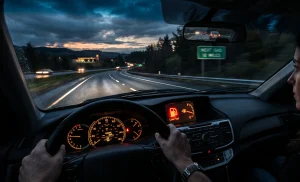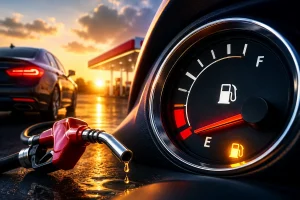
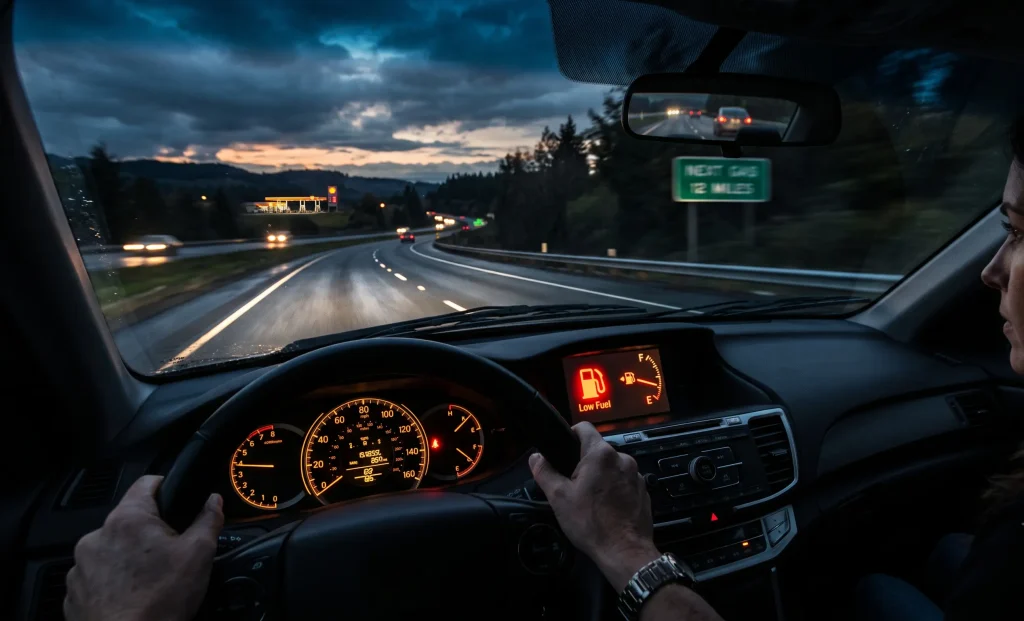
Every driver knows the feeling. You glance at the dashboard and there it is, that small amber pump icon, glowing steady. A quiet, unwelcome guest. The next station is farther than you’d like, the traffic ahead looks slow, and a small voice in the back of your head starts calculating.
I’ve spent the better part of two decades around cars, first learning the trade in a family workshop, later working as a technician on everything from small hatchbacks to fleet pickups. And in all that time, no dashboard warning has generated more anxious phone calls to the shop than the low fuel light. “How far can I really go?” people ask, usually already driving. “Am I going to be stranded?”
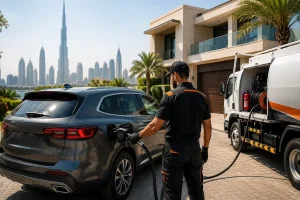
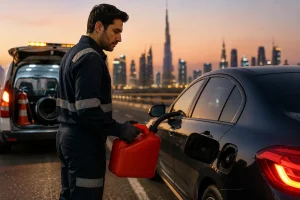
The honest answer is: most modern passenger vehicles can travel roughly 30 to 50 miles (about 48 to 80 kilometres) after the low fuel warning light turns on, but the real story is more interesting, and a lot more useful, than a single number. And if you’re ever genuinely caught out on the road, a same-day fuel delivery in Dubai service can reach you faster than you’d expect, so that glowing amber icon doesn’t have to turn into a real emergency.
Let me walk you through what actually happens when that light comes on, what your car is really telling you, and why one common habit will cost you a fuel pump long before it leaves you on the shoulder.
The Quick Answer (For the Driver Who’s Already Nervous)
If you just pulled over to check this: breathe. In most vehicles built in the last fifteen years or so, you have somewhere between 30 and 50 miles of usable range after the low-fuel light illuminates. Larger SUVs and full-size trucks often give you closer to 60 or 70. Small hatchbacks give you closer to 25.
That range assumes moderate speeds on reasonably flat roads with a healthy fuel system. It shrinks quickly on hills, in heavy traffic, at high highway speeds, or if your tank is old enough that sediment has collected at the bottom.
If a station is within reach on your current route, you’re almost certainly fine. Drive smoothly, ease off the accelerator, and skip the AC if you comfortably can.
Now, the story behind that number.
What the Fuel Light Is Actually Telling You
Here’s something most drivers don’t realise: the low fuel warning light isn’t triggered by a “you’re about to run out” signal. It’s triggered by a fuel level sensor a small float inside your tank connected to a variable resistor that tells the car’s computer when the remaining fuel drops below a preset threshold.
That threshold, in almost every mainstream vehicle, corresponds to a reserve of roughly 10 to 15 percent of total tank capacity. Engineers build that buffer in on purpose. They know drivers are human. They know we misjudge, get distracted, hit unexpected traffic, or drive past the last station thinking there’ll be another one soon (there won’t be).
On a mid-size sedan with a 55-litre tank, that reserve translates to somewhere between five and eight litres of usable fuel. Depending on how the car is being driven, that’s typically enough for another 50 to 80 kilometres of driving. On a full-size pickup, the tank is larger and the fuel consumption higher, so the reserve gives similar range in numbers but disappears faster in stop-and-go traffic.
The pattern holds across brands: the light is designed to give you enough range to comfortably find a station, not enough to gamble on.
Realistic Ranges for Common Vehicles
These figures come from a mix of manufacturer specifications and, more importantly, the range owners actually report after the light comes on. Real-world variation is significant, so treat these as the middle of a bell curve, not a promise.
Compact and midsize sedans
- Toyota Corolla: around 40 to 55 miles
- Honda Civic: around 45 to 60 miles
- Toyota Camry: around 55 to 75 miles
- Honda Accord: around 50 to 70 miles
- Hyundai Elantra: around 40 to 55 miles
SUVs and crossovers
- Toyota RAV4: around 45 to 60 miles
- Honda CR-V: around 45 to 65 miles
- Ford Explorer: around 40 to 55 miles
- Jeep Grand Cherokee: around 35 to 50 miles
Trucks and pickups
- Ford F-150: around 50 to 75 miles
- Chevrolet Silverado 1500: around 45 to 65 miles
- Toyota Tacoma: around 40 to 55 miles
Small hatchbacks and economy cars
- Suzuki Swift: around 30 to 45 miles
- Hyundai i10 / Kia Picanto: around 25 to 40 miles
- Volkswagen Polo: around 35 to 50 miles
If your vehicle isn’t listed, a workable rule of thumb: take your fuel tank size, multiply by roughly 0.12, and multiply that number by your typical fuel economy. That gives you a rough estimate of your reserve range.
The Mistake That Quietly Ruins Fuel Pumps
Here’s the part most articles skip, and it’s the part that matters most from a technician’s chair.
Your fuel pump lives inside your fuel tank, submerged in fuel. That’s not a design flaw it’s deliberate. The surrounding fuel cools the pump’s electric motor and helps lubricate its internal components. As long as the pump stays bathed in fuel, it can run for well over a hundred thousand miles without complaint.
But when the fuel level drops low enough that the pump starts sucking air even briefly, even intermittently things start to go wrong. The motor runs hotter without the fuel bath carrying away heat. The pump strains harder to maintain pressure. And critically, it starts pulling in whatever has settled at the bottom of the tank: fine sediment, rust particles, water condensation, and years of accumulated debris.
That material gets forced through the fuel filter and, when the filter starts to clog, on toward the injectors. In my experience, drivers who habitually run their tanks down to the warning light replace fuel pumps more often than drivers who don’t. A replacement pump plus labour is typically a several-hundred-dollar repair, and it’s exactly the kind of bill that would have been avoided by refuelling earlier.
So when someone asks me how far they can drive after the light comes on, I have two answers. The one for the driver: “Probably 40 miles or so, but why are you finding out?” The one for the car: “You did this again, didn’t you?”
What Actually Shrinks Your Range
The published ranges assume conditions that don’t always match reality. Here’s what steals miles once that light is on:
High highway speeds: Wind resistance climbs sharply with speed. Cruising well above the flow of traffic can cut your reserve range meaningfully compared to easier cruising speeds.
Uphill grades: Sustained climbing burns fuel far faster than flat driving. It also causes fuel to slosh backward in the tank, which can starve the fuel pickup momentarily and cause the engine to stumble even when fuel is still available.
Air conditioning: On smaller engines especially, running the AC at full blast noticeably reduces fuel economy.
Stop-and-go traffic: Every acceleration from a standstill burns a small burst of fuel. On low reserves, a string of red lights or crawling congestion will punish you.
Cold weather: Cold engines run a richer mixture until they warm up, and on short trips they may never fully warm up. Winter reserve ranges tend to be shorter than summer ones.
Steep tank angles: On a significant incline with a nearly empty tank, the sensor may read inaccurately in either direction, and the fuel pickup can struggle to draw fuel reliably.
What to Do the Moment Your Fuel Light Comes On
Don’t panic you’ve got more time than you think. Here’s the exact sequence to follow, in order.
1. Ease off the gas:
If you’re on the highway, bring your speed down toward the more efficient range. This alone buys you extra miles.
2. Kill the AC:
Turn it off if it’s not a safety issue. At lower speeds, cracking a window works fine. At highway speeds, keep them closed — the AC actually costs you less than the wind drag.
3. Find stations ahead of you, not just nearby:
Open your maps app and search along your route not the closest one as the crow flies. The nearest station on the map might be behind you or off an exit that costs you more fuel to reach than it saves.
4. Drive smooth:
No hard acceleration, no hard braking. Coast toward red lights instead of powering up to them and stopping short.
5. Skip the hills:
If there’s a flatter route available, take it even if it’s a little longer. Climbs burn more than the extra distance costs you.
6. Trust the recalculation:
Modern dashboards update your range estimate based on recent driving behavior. Drive gently for a few minutes and watch the estimate tick back up that’s the car confirming your smoother driving is working.
But if the tank runs dry before you reach a station, That’s exactly what we’re here for. Dubai Fuel Delivery brings gas straight to your location highway shoulder, parking lot, driveway, wherever you’re stuck ( if your are in duabi ). No tow truck, no long wait, no walk to a gas can.
Myths That Refuse to Die
Running low draws bad fuel from the bottom of the tank:
Partly true, but not for the reason people think. Modern fuel pickups draw from very near the bottom regardless of fuel level; sediment gets pulled through constantly. The real problem is that a low tank exposes the fuel pump to air and heat, not that low fuel is somehow “dirtier” fuel.
An empty tank means better fuel economy because the car is lighter:
Technically true, and practically meaningless. Fuel doesn’t weigh enough to make a measurable difference on a passenger vehicle. Driving style, tyre pressure, and traffic completely overwhelm any weight effect.
The distance-to-empty display is exactly how far you can go:
It’s an estimate based on recent averages, and it’s often optimistic when you’re accelerating and pessimistic when you’re coasting. Use it as guidance, not gospel.
Diesel engines can safely go further after the light:
Some can, because diesel tanks are often larger. But diesels are much less forgiving of running dry air in a diesel fuel system can require professional bleeding before the engine will restart cleanly. Don’t push a diesel to empty.
Frequently Asked Questions
Is it bad to drive on low fuel regularly?
Yes. The recurring stress on your fuel pump is the biggest concern. Occasional low-fuel driving is fine. Making a habit of it will shorten the life of an expensive component.
Can the low fuel light be wrong?
Rarely, but yes. A failing fuel level sensor can trigger the light early or late. If the light comes on when you know the tank is half full, or fails to come on when you’re clearly low, have the sensor checked.
How long can I sit idling on the reserve?
Most modern engines burn a small fraction of a gallon per hour at idle. A couple of gallons in reserve gives you a surprising amount of idle time on paper but idling in an enclosed space is dangerous for other reasons, so this is largely theoretical.
Does the light come on at the same level every time?
Yes, in almost every vehicle. It’s a fixed threshold based on the fuel sensor’s resistance value.
What if I’ve already run out?
Coast to a safe spot with your hazards on. On most modern fuel-injected vehicles, running dry doesn’t immediately damage the engine, but the fuel pump can be compromised. After refuelling, expect the engine to crank longer than usual as the fuel system re-primes. If it doesn’t start after fifteen to twenty seconds of cranking, stop trying and call for help you don’t want to drain the battery.
Does turning off the radio and lights save fuel?
Marginally. The alternator does work slightly harder to power accessories, but the effect is negligible. Focus on speed and smoothness instead.