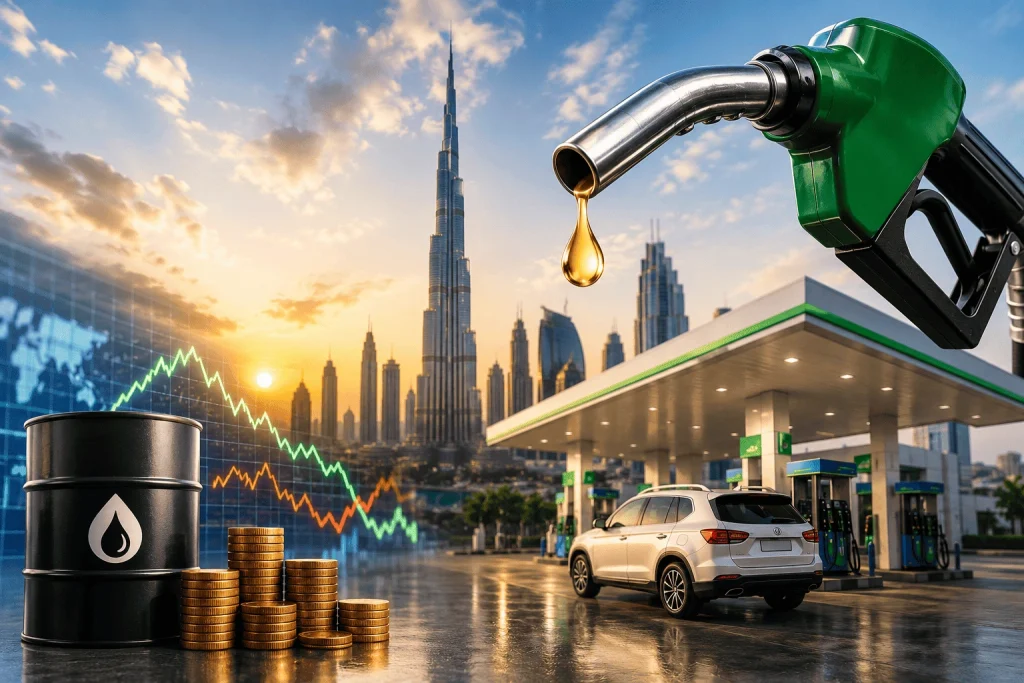
Rewind to February 2026: a litre of Special 95 in the UAE cost around Dh2.45, and most drivers barely thought about the number on the pump. Four months later, they couldn’t think about anything else. By June, that same litre had climbed to Dh3.83, part of a broader surge that pushed petrol up more than 60% in four months, driven by the US-Israel-Iran conflict and the disruption to shipping through the Strait of Hormuz. A driver filling a typical 60-litre sedan went from paying about Dh147 to roughly Dh237 a tank, an extra Dh90 a month, every month, for the same commute.
Then, on July 1, relief: prices fell across every grade, with Special 95 dropping back to Dh3.29. That whipsaw, a steep climb followed by a sharp cut, is the clearest recent illustration of a question drivers ask at the end of every single month: will Dubai petrol prices go down?
The honest answer is that no one can promise a direction, but you can understand exactly what moves the number, and that changes how you plan. In this guide, I’ll break down how UAE fuel prices are actually set, the global and regional forces behind each monthly change, including the UAE’s landmark exit from OPEC in May 2026, and practical ways to protect your budget whichever way the next announcement goes. And on the months when the number at the pump catches you off guard mid-drive, a reliable fuel delivery in Dubai service is worth having on hand, so a tight budget never turns into an empty tank at the worst possible time.
How Are Petrol Prices Set in Dubai?
Unlike countries that subsidise fuel to keep pump prices fixed, the UAE uses a market-linked monthly pricing system. Since fuel-price deregulation in 2015, rates have been reviewed and reset every month to track international oil markets which is why the number on the pump can look very different from one month to the next. The prices are set by the UAE Fuel Price Committee and announced on the final day of each month via the Emirates News Agency, taking effect on the 1st.
How much movement that can mean in practice: in 2026, Special 95 ran at roughly Dh2.45 in February, climbed to Dh3.83 by June, then fell back to Dh3.29 for July a real illustration of how directly this system passes global market swings through to drivers.
Several factors feed into each monthly decision:
| Factor | How it affects fuel prices |
|---|---|
| Global crude oil prices | The biggest driver, the committee uses the previous month’s average oil price, so a change shows up the following month. |
| International supply and demand | Shifts in global production and consumption move the underlying oil price. |
| Refining costs | Converting crude into finished petrol adds to the final figure. |
| Distribution and logistics | Transporting and storing fuel across the UAE adds cost. |
| Geopolitical & market conditions | Conflicts, shipping disru英tions, and seasonal trends can swing prices sharply, as the 2026 spike showed. |
Because prices are pegged to the prior month’s oil average rather than daily swings, a fall in crude today typically reaches the pump the following month a timing detail that helps explain why relief can feel delayed.
Why Do Dubai Petrol Prices Change?
Many people assume petrol prices only depend on oil prices. In reality, several interconnected factors influence the monthly price of fuel.
1. Global Crude Oil Prices
Crude oil is the primary raw material used to produce petrol. When international oil prices increase, fuel production becomes more expensive, which can eventually lead to higher petrol prices in Dubai.
On the other hand, if crude oil prices decline due to weaker demand or increased production, fuel prices may also decrease.
2. OPEC+ Production Decisions
The UAE is a member of OPEC+, a group of oil-producing countries that work together to manage oil production.
When OPEC+ decides to reduce production, the global oil supply may tighten, often supporting higher oil prices. If production increases, supply may improve, potentially easing pressure on fuel prices.
However, OPEC+ decisions are only one piece of a much larger global market.
3. Global Supply and Demand
Fuel prices are strongly influenced by the balance between supply and demand.
Demand often increases when:
- Global economies are growing
- More people travel
- Industries require more energy
- Freight and shipping activity rises
Conversely, slower economic activity can reduce fuel demand, sometimes putting downward pressure on prices.
4. Seasonal Demand
Certain times of the year naturally see higher fuel consumption.
Examples include:
- Summer travel seasons
- Public holidays
- Increased airline activity
- Higher road transport demand
- Tourism peaks
Seasonal demand doesn’t guarantee higher prices, but it can influence overall market trends.
5. Geopolitical Events
Global energy markets are sensitive to geopolitical developments.
Events such as:
- Regional conflicts
- Trade restrictions
- Shipping disruptions
- International sanctions
- Natural disasters affecting oil production
can all influence crude oil supply and create price volatility.
These events are difficult to predict, which is why fuel prices can sometimes change unexpectedly from one month to the next.
6. Refining and Distribution Costs
Before crude oil reaches your vehicle, it must be refined into petrol and transported to service stations across the UAE.
These processes involve:
- Refinery operations
- Storage
- Transportation
- Distribution infrastructure
- Operational costs
Changes in these costs may also influence the final retail fuel price.
Could Petrol Prices Go Down?
Fuel prices depend on changing global market conditions rather than fixed schedules or guarantees.
Instead of making predictions, energy analysts monitor several indicators that may influence future pricing, including:
- International crude oil prices
- OPEC+ production announcements
- Global economic growth
- Fuel demand trends
- Inventory levels
- Shipping and logistics costs
- Geopolitical developments
If these factors combine in a way that reduces pressure on oil markets, petrol prices may decrease. If market conditions tighten, prices may increase instead.
For this reason, it’s best to rely on the official UAE petrol price update released each month rather than speculation shared online.
How Fuel Prices Affect Drivers and Businesses
Fuel price changes affect much more than individual motorists.
Everyday Drivers
Higher petrol prices can increase the monthly cost of:
- Commuting to work
- School runs
- Weekend travel
- Family outings
- Daily errands
Even small monthly increases can add up over time for households with multiple vehicles.
Businesses
Companies operating fleets often feel the impact even more.
Industries such as:
- Delivery services
- Logistics
- Construction
- Transportation
- Field services
- Taxi and ride-hailing
may experience higher operating costs when fuel prices rise.
Many businesses actively monitor monthly fuel prices to better manage budgets and improve operational efficiency.
Tips to Reduce Fuel Costs
While you can’t control fuel prices, you can reduce unnecessary fuel consumption with smart driving habits.
Maintain Proper Tyre Pressure
Underinflated tyres create more rolling resistance, causing your vehicle to consume additional fuel.
Drive Smoothly
Avoid rapid acceleration and harsh braking whenever possible. Consistent driving generally improves fuel efficiency.
Plan Your Trips
Combining errands into one journey reduces unnecessary mileage and fuel consumption.
Keep Your Vehicle Serviced
Regular maintenance helps engines run more efficiently and may improve fuel economy.
Remove Excess Weight
Carrying unnecessary items increases fuel consumption, especially during city driving.
Consider Dubai Fuel Delivery
Mobile fuel delivery in dubai offer added convenience by bringing fuel directly to your home, office, or business location. Besides saving time spent driving to a petrol station, scheduled refuelling can help businesses keep fleet operations running efficiently and reduce downtime.
Conclusion
So, will Dubai petrol prices go down? The truth is that no one can accurately predict future fuel prices with certainty. Monthly fuel prices in the UAE are influenced by a combination of global crude oil prices, OPEC+ production decisions, international supply and demand, refining costs, distribution expenses, and geopolitical developments.
Instead of relying on rumors or unofficial forecasts, it’s best to follow the official monthly fuel price announcements. Understanding what drives fuel prices can help you make informed decisions about your travel, budget, and business operations.
Whether prices rise or fall, adopting fuel-efficient driving habits and using convenient solutions like fuel delivery in Dubai can help reduce the impact of changing fuel costs on your daily routine.
Frequently Asked Questions
Will Dubai petrol prices go down?
Petrol prices in Dubai may go down if global oil market conditions improve, but there is no guaranteed way to predict future prices. Monthly fuel prices are based on several market factors, including crude oil prices, supply and demand, and production levels.
Why do UAE petrol prices change every month?
The UAE follows a monthly fuel pricing system that reflects international market conditions. Fuel prices are reviewed each month to account for changes in global crude oil prices, refining costs, transportation expenses, and overall market trends.
Who decides fuel prices in Dubai?
Fuel prices are announced monthly under the UAE’s fuel pricing system. The prices reflect international oil market conditions and are officially published before taking effect on the first day of each month.
When are UAE fuel prices announced?
New fuel prices are typically announced during the last few days of each month and become effective from the first day of the following month.
Are Dubai fuel prices linked to global oil prices?
Yes. Dubai petrol prices are closely linked to international crude oil markets. However, other factors such as refining costs, logistics, supply and demand, and geopolitical events also influence the final retail price.
Does fuel delivery cost more than filling up at a petrol station?
It depends on the fuel delivery provider. Many fuel delivery companies offer competitive pricing while adding value through convenience, time savings, and scheduled refuelling for individuals and businesses. Always compare pricing and service terms before choosing a provider.